I used $30,983 of AI tokens last month in Claude code on $200/mo plan
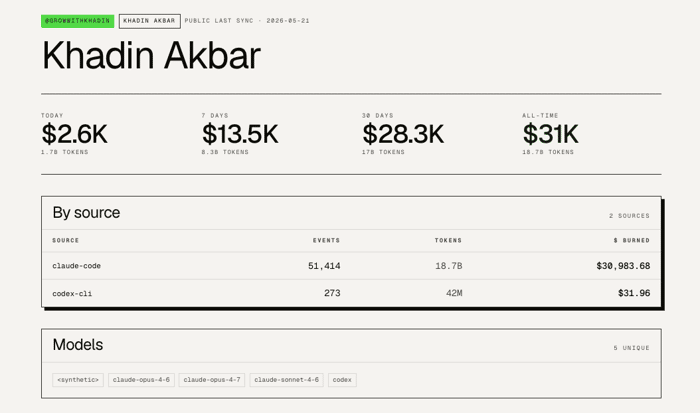
I built tokenflex.ing — a public leaderboard where devs and vibe coders can show off how much ai tokens they have used with Claude Code, Codex, OpenCode, Cursor and other AI tools.
Kind of like a GitHub profile, but for AI token usage.
My profile so far:
- 18.7B tokens all-time
- 17B tokens last 30 days
- 51,414 Claude Code events
- 5 models (Opus 4.6, Opus 4.7, Sonnet 4.6, Codex, synthetic)
- Currently rank #4 today
Funny thing is nobody actually knows their actual token usage until they look. You assume you're using "a lot" of Claude. Then you see 12B tokens for the
month and have to quietly close the tab.
What does yours look like?
Especially if you're curious about anyone running Claude Code + Cursor + Codex together you must compare your usage with them.
You should try tokenflex.ing if you want to do that.

amazing... that's crazy bro
thanks man
BUT how do you track token count for the claude desktop or web?
we use claude code instance for that
superb bro....
thanks
innovative actually
thanks for your kind words i would recommend checking it out
Token spend at that scale really depends on how much you lean on the agent for exploratory reads vs targeted edits — I've found reviewing diffs before they land cuts burn rate a lot since it stops cascading re-reads when an edit goes sideways. Put together a comparison of terminal-based agents on exactly this diff-review behavior if it's useful: https://www.openaitoolshub.org/en/blog/opencode-review-terminal-ai-coding
Waouh very good job
Thanks man... did you gave it a try?
is it for mac only or it works on windows as well?
it works on both using cli
the 'quietly close the tab' bit made me laugh. but real talk — token count without output metrics is just measuring how hard your AI had to work, not how much you shipped. ive seen devs burn way fewer tokens and ship more because they structure their prompts better upfront instead of doing 20 retry loops
After trying Claude Code for two weeks, I felt that before I could create any profitable products/tools, I was already incurring token costs upfront. I realized I couldn't simply let the tool control my wallet, so I looked for some effective open-source libraries on GitHub and used them in conjunction with Claude Chat to significantly reduce token expenses. Perhaps this is why I won't be able to achieve a good ranking on this site you provided.
did you find it was still effective with those libraries?
Yes, but I haven't conducted large-scale testing yet. Just after adding it, normal usage did indeed reduce token usage, but often it's only after further testing that one can determine if it's effective.
On the $200/mo plan, the cheapest single optimization is moving file-reading and grep-style operations to a cheaper model (Haiku / Sonnet) and keeping Opus only for actual reasoning steps — Claude Code respects a model override per subagent and you can cut token spend 40-60% without quality loss for routine ops. Second lever: cache_control headers on long system prompts / repo context so you're not paying full input tokens on every turn; Anthropic's prompt caching is dramatically underused.
17B tokens in 30 days is the number that makes the leaderboard idea work as a product, not just as a flex. Most devs genuinely have no idea what they're burning, so the moment they see a ranked list they'll check just to find out where they stand. The interesting question is whether you add a ratio layer eventually: tokens-per-shipped-commit or tokens-per-closed-issue. Raw burn is compelling to compare, but the number that actually changes behavior is 'am I using 3x more tokens than someone shipping the same output?' The leaderboard is the hook; that ratio is what would make someone open it every week.
i think that's a much needed service industry needed and this thing hasn't been launched anywhere till now that's the most concerning part.
this is great man
Thanks alot bro
i will try it for sure
thanks will be waiting for your thoughts on it
Hi Khadin, TokenFlex turns measurable AI usage into a public identity, so your work is unusually close to the proof-and-badge mechanics we are testing. I’m building Build Before 2030: a manually reviewed public record where makers claim a Founding 100 number, set one measurable 30-day milestone, and later add proof of what shipped. The first cohort is free. TokenFlex feels like a strong fit. Interested? https://buildbefore2030.com
Hey, $30,983 in tokens with no clear breakdown of where it went is exactly the problem I'm trying to solve. I'm a CS student building a small tool that tags AI API spend by feature/workflow so you can see which part of your work actually drove that kind of spike instead of finding out after the fact.
Before I build more of it, I want to make sure I'm solving the right problem. Quick questions if you don't mind:
No pitch, just trying to validate before I sink time into building the wrong thing. Appreciate any honesty.
$30k of compute against $200 in subscription is wild on its own, the more interesting number is what shipped. Curious to know your token-to-merged-PR ratio. I keep seeing this kind of usage where the bulk goes into one or two refactor passes and the rest is the agent exploring directions that never made it to main.
Context bloat is the silent budget killer — your point about 8-12k tokens just for session startup matches exactly what I found when I started auditing my own CLAUDE.md files. The fix that moved the needle most for me: keeping the CLAUDE.md under 80 lines with hard rules (no prose, only directives) and routing all boilerplate prompts through slash commands instead of free-form chat. The rules file stops the agent from re-discovering project conventions every session. I published stack-specific CLAUDE.md templates (Python, TypeScript, Go, Swift, Rust, Vue) with 13 rules each — mostly built around this exact problem. Happy to share if useful here.
I’m slowly coming to the same conclusion many people here seem to have reached already: flat pricing and flat request accounting stop working very quickly once you build around AI.
In CoTel, several parameters affect the real cost of a request:
history depth,
number of chats,
subscription frequency,
analysis complexity,
and of course the model itself.
Because of that, I’m currently testing 8 models from different providers to understand which models are actually better for different categories of tasks and how to build an internal routing system around them.
My current idea is to hide model selection from most users entirely and instead expose something simpler like:
Fast,
Balanced,
Deep.
Then the backend decides which model is most efficient for that type of request.
And honestly, even halfway through testing, I’m already seeing how dramatically costs can change depending on correct model routing — sometimes with surprisingly small quality differences.
I think this is something every AI SaaS product eventually runs into once real users and real workloads start appearing.
Pure vanity math. Token count without shipped features tells you one thing: how hard the AI worked. What actually shipped is a different number entirely. I ran Claude Code pretty hard for about 3 months on agent workflows, and the thing that actually changed my spend was session hygiene: keeping each session scoped to one problem, resetting context before it ballooned, and routing repetitive low-stakes subtasks to Haiku instead of Sonnet. That cut my spend by roughly 37%, delivery speed unchanged.
The leaderboard is a fun idea. But rank 4 globally tells you either that you shipped something serious, or that you left Claude running in a loop with a bad prompt and went to bed. Without an output metric next to the token count, it doesn't say much.
Session hygiene saves a massive amount of budget. Keeping context windows clean and offloading basic subtasks to lighter models cuts costs significantly without lowering output quality.
Yeah, the model-routing piece is the one most people skip because it feels fiddly to set up, but that is where most of the savings sit. The clean-context habit is the harder part to keep up once a deadline hits.
Damn 17B tokens in the last 30days...
This is a strong flex mechanic. The bigger thing I keep seeing with Claude Code/Codex users is that people do not just want leaderboard stats, they want usage visible before they hit the wall.
That is why I built TokenBar as the boring companion version: Mac menu bar visibility for AI usage, limits, and reset times while you work. If anyone here is getting surprised by resets, it is here: https://tokenbar.site
I burn through tokens in Claude Code too, and one thing I have noticed: the way I type prompts versus the way I speak them is completely different. When I type, I get wordy and over-explain. When I dictate the same prompt, it comes out tighter because speaking forces conciseness. You naturally edit yourself.
I built DictaFlow partly for this. It is a hold-to-talk dictation app that types into any window, including the Claude Code terminal. Hold a hotkey, speak the prompt, release, and it shows up at your cursor. The side effect I did not expect: my prompts got shorter and my token burn dropped noticeably just from switching to voice.
Anyone else here dictating their Claude Code prompts, or is everyone still typing everything?
the 200/mo to 30k tokens math is unreal but its less about the plan and more about how you scoped Sonnet vs Opus. when claude-code defaults to Opus for plan + Sonnet for impl, my burn dropped 60 percent. the heavy hitters arent the obvious ones either - the silent killer is bash output flowing back into context. a single
find /or huge log tail spike eats 50k tokens you never see in the UI. /usage in 2.1.149 finally surfaces where this happens.haha I really love this I've only been coding 20 months using Claude code not really building anything until the last 3 weeks i Hit an idea. my genric token useage has never gone above 20,000 my usage so far in 3 weeks of building is 200,000
but this is a my Ferrari is better than yours
The slogan "Burn tokens. Get famous." is honestly great.
One fun product idea: maybe you could add a "real-world impact" layer next to token usage.
Not in a moralizing way, but as a more visual/funny comparison. For example:
Tokens are already a good flex metric, but translating them into real-world analogies could make the leaderboard much more shareable. People understand "17B tokens", but they feel "that's 200 kettles of energy" much faster.
Running 10+ apps across iOS and web, my biggest token lesson wasn't about which model to use — it was about when NOT to use AI at all.
Three things that cut my monthly Claude Code spend by roughly 65 percent:
Pre-written project instruction files. Instead of letting the agent rediscover your codebase every session, give it a structured map upfront. Saves thousands of tokens per session in context discovery alone.
Task-size discipline. The moment a task touches more than 3 files, I break it into subtasks with explicit specs. Large ambiguous tasks are where 80 percent of retry loops and token waste happen.
Knowing when grep beats AI. File searches, simple refactors, find-and-replace — every unnecessary AI invocation is tokens you will never get back.
The raw number is fun to flex, but what actually matters is tokens-per-shipped-feature. I would bet the top performers on that metric are burning way less than the leaderboard leaders.
The cost creep is real. Building a fitness AI app and I hit this early — had to get deliberate about routing. The fix that helped most: only use the heavy model for reasoning-heavy tasks and route everything else to a cheaper/faster model. For my app I use Gemini Vision for food photo scanning and Llama 70B via OpenRouter for the conversational AI — each doing what it's actually good at. Costs dropped significantly without hurting quality. Claude Code is harder to control since it autonomously picks the model, but for product-facing AI you have full control.
$30k worth of tokens on a $200 plan is absurd leverage. This is exactly what the AI era looks like—tiny teams, massive output.
The token cost conversation is almost always the wrong cost conversation in enterprise B2B. In our deployments, the AI compute line item is usually 10-15% of total project cost. The other 85% is data sanitation, integration engineering, and the organizational overhead of getting 6 different stakeholders to approve data access.
The $30k token bill is visible. The 3 months of eng time building around it usually isn't in the same spreadsheet.
This is a brilliant idea — GitHub profile but for AI token usage. As someone who uses Claude heavily for building side projects, I had no idea how to track actual token consumption. Going to check it out!
This is a really neat concept! It’s like a fitness tracker or a GitHub contribution graph, but specifically for AI developer throughput. As developers start moving more toward autonomous agents and CLI tools like Claude Code, visibility into token consumption is becoming essential to catch cost spirals early. I love the idea of making it social—it could actually gamify code efficiency! One cool feature suggestion: it would be great to see a breakdown of tokens consumed per line of code committed or features merged, rather than just raw volume. Keep up the great work.
This is an incredible breakdown of token burn. From an optimization perspective, managing that level of raw API text payload throughput can get complex quickly if the underlying application structures are flat.
I’ve been deep in systems architecture since the legacy mainframe days, and it's fascinating to watch modern platforms consume resources at this velocity. For high-concurrency architectures, keeping token parsing overhead lightweight—such as executing localized translation event loops via asynchronous serverless webhooks—is absolutely vital to stop the infrastructure costs from outpacing baseline product margins. Great data here!
The root cause in most agentic cost spirals isn't the model —
it's missing call velocity tracking. Raw token counts tell you
what happened. Call velocity (second derivative of tool calls
per minute) tells you 3-4 minutes before it becomes expensive.
What I've seen work in production:
Track call acceleration, not just volume. If an agent goes
from 2 calls/min to 6 calls/min to 14 calls/min, that
exponential curve trips a circuit breaker before you hit $500.
Separate budget pools per agent. A verification agent
shouldn't share quota with a generation agent — they have
completely different call patterns.
Add a deduplication registry. If the same fact was verified
in the last 5 minutes, return the cached result. Alone this
cuts 40-60% of runaway verification loops.
I've been analyzing this pattern across multiple agentic systems
recently. Happy to share what the monitoring signals look like
in practice — DM me if useful.
The "you assume you're using a lot until you actually look" line is real. Running gpt-4o across blog generation, SEO scoring, and keyword research for 6 SaaS apps — I stopped guessing my usage after the first month and just started treating it as a fixed infrastructure cost like hosting. The surprise was how uneven it is: the blog generator burns 10x what the route optimizer does, even though I assumed the opposite. Checking out tokenflex — that kind of visibility would actually help me optimize which features justify the compute.
Same "quietly close the tab" energy when I tracked $/hour on my 4 side projects. One was $1.80/h 😬
30k tokens on Claude Code in one month is wild - do you have any workflow tips for keeping context manageable without burning through the budget?
Really appreciate you sharing the numbers transparently. The part about "validation before building" resonated — I actually fell into that trap too with my first project. What channel ended up driving your first 10 signups?
Raw token totals are interesting, but the useful metric for founders is tokens burned before a decision or shipped artifact exists.
I would split usage into three buckets: exploration, production work, and repair/retry waste. The last bucket is where most teams learn something actionable, because it points to unclear specs, too much context, or weak stop conditions rather than simply "AI is expensive."
didn't realize how much autonomous agents cost until month 2. I now write a constraints doc per agent before deploying - it's dumb but it forces the cost question upfront.
Cool concept. What I'd want to see next is tokens-per-outcome, not just raw tokens. At SocialPost we ship a lot with AI tooling but raw usage tells me nothing without context: was that 12B tokens behind 3 shipped features or 30? Pairing token spend with merged PRs or deployed features turns this from a vanity leaderboard into something that actually helps founders make better tooling decisions.
interesting concept - turns claude-spend from private guilt to public game. would love a second axis though, like commits-per-1B-tokens, to balance the 'most burned wins' vibez
Fun idea, but isn't the point to be productive with the least amount of token spent?
Fun hook. But I’d love to see the next layer: what did those tokens actually ship?
Tokens per merged PR / fixed bug / shipped feature would be way more useful than raw burn. Otherwise the leaderboard might just reward chaotic workflows 😂
claude code only over here no cursor/codex. mostly long-context flutter work. the 'quietly close the tab when you see the number' part felt personal lol
This is exactly why I built TokenWatch — paste your API key, get a weekly email showing exactly where the spend is going. No code changes. Check my profile for link.
it is probably the best way to "purchaise" more tokens
Wild numbers! The leaderboard idea is genuinely clever — most devs have no idea what they're actually burning until they see it ranked next to someone else. Checking mine now.
" Fascinating optimization metrics here. As a legacy systems engineer who started back when every single byte had to be manually declared on mainframes, seeing token burn at this velocity is wild. The shift to letting models handle boilerplate and heavy text formatting changes the game entirely, provided the core system design logic stays human-driven."
The ROI math here is what matters — if those tokens generated more than $30k in output value (saved dev time, shipped features, avoided costly mistakes), then it's actually cheap. The interesting shift I'm watching is founders using AI not just for coding but for decision-making before they write code at all. I've been building in the validation space and the most painful thing I see is teams that spent months building something that six honest AI critics could have torn apart in an hour. The compounding cost isn't the tokens — it's building the wrong thing faster.
This is a great breakdown of the token efficiency problem. The gap between what API providers advertise and what developers actually experience in production is massive. Building with AI infrastructure costs requires constant monitoring — the $200 plan being enough for this scale is genuinely surprising.
This is wild – the leaderboard idea is genius. Nobody tracks this until they see the number and regret it. Curious how you're pulling the token data – is it directly from Claude Code logs or via API? Building on top of Supabase for the storage layer?
Have you built this for Arduino? A little 3D-printed display would be so cool
Can I get one
$30,983 in tokens on a $200 plan means Anthropic is subsidizing roughly 99% of your usage. Fun while it lasts. The thing I keep watching is when pricing tightens, rate limits cinch, or the unlimited tiers quietly disappear. Pattern from 20 years of running SaaS: you build the cost structure assuming you pay the real number, not the introductory one. Curious who here has actually budgeted for what their stack costs at list price.
$30,983 of compute on a $200/month plan is wild, and the leaderboard idea is smart because it makes something invisible very visible. Most devs genuinely have no idea what they're actually burning until you put the number in front of them.
One thing I'd push back on slightly: there's a fork in who actually wants this data. Devs who are proud of their usage want a leaderboard. Finance directors and bootstrapped founders building on top of these models want a cost alert. Trying to serve both might dilute the angle.
Which behaviour have you seen more of in the early users -- people showing off their number, or people genuinely shocked by it?
I've been building KundliAI — an AI astrology platform for the Indian market — mostly through Claude ai chat rather than Claude Code, so my token burns look modest in comparison. But the moment I started using it for actual code generation and debugging, I could feel the tokens disappearing in real time.
The funniest part of your post — "you assume you're using a lot, then see 12B tokens and quietly close the tab" — hit different. I had a similar moment when I saw my AstrologyAPI costs after a single day of decent traffic. The math changes fast when real users show up.
Curious — at $30k of usage, are you seeing proportional output in terms of shipped features or revenue? Trying to calibrate whether heavy Claude Code usage actually accelerates building or just feels like it does.
nice stuff
It seems like a very useful tool, but there's nothing like trying it out and seeing how it really works and if it's useful. Nowadays, with AI, those who are observant get ahead. Good luck on your journey...
18B tokens for what? I can't wait for the count to be based on token usage rather than by plan...
I am building multiple projects as i am too bullish on indiehacking and built this because thought similar minded people can hangout there.
Fascinating — and a bit terrifying. The cost spiral you're describing is almost always a governance problem before it's a budget problem: no validation gate means the model runs until it's done, not until it's right. We built ConsensusPress exactly for this — five models reach consensus before a single word publishes, so you're paying for validated output, not iteration. Would love to know if you found a ceiling that worked.
new normal
yupp... that's why i thought we should have a public leaderboard to flex our usage.
"17B tokens in a month is an absolute flex, Khadin! Turning token usage into a gamified leaderboard is such a clever and fun idea for devs right now. It's like the new GitHub profile. Awesome project, congrats on the launch!"
Thanks man let's compete on tokenflex.
I am absolutely mortified by this and intrigued at the same time, I am bookmarking this because I am going to come back when I am less afraid of seeing this metric.
hahaha... what about competing on tokenflex.
I like the idea I really do, but I feel mine would say something like 1 trillion and I would be so embarrased and close my laptop forever
This is crazy bro! Though what’s fascinating is that token cost is quickly becoming a secondary optimization compared to workflow efficiency.
We’ve seen cases where:
…reduced retries and hallucinated implementation so much that total operational cost dropped massively even when using “more expensive” models.
A lot of AI engineering right now feels less like prompt engineering and more like systems engineering.
Yupp you are absolutely right but the more fascinating thing is the margin that anthropic offers between a monthly plan and a token based usage system i mean api system.
that's insane. trying to be like you one day
Thanks man, sure let's compete on tokenflex.ing than
Building a leaderboard for Claude token usage is such a clever idea! This scratches a real itch for devs who want to understand their actual AI spend vs what they think they're spending. The tokenflex.ing project is exactly the kind of transparency tool indie hackers need. Love the transparency angle! 🚀
17B tokens in 30 days is a mind-blowing flex! Honestly, the margin that Anthropic is currently subsidizing on these pro plans compared to raw API costs is insane.
What’s really fascinating from a backend perspective is how we process and visualize this scale of data. I’m currently building an AI-powered social listening and lead-generation tool, and my biggest headache right now is filtering the absolute noise so the incoming lead table doesn't completely flood the user's UI. Seeing your 51,414 Claude Code events just makes me think about the pure data pipelines running under the hood here.
Definitely bookmarking —gamifying token usage like a GitHub contribution graph is brilliant for the AI-native dev era.
About $1,000 deep in Claude Code tokens building a CRM from scratch. The thing that surprised me wasnt the total spend, it was how much was wasted on lazy prompts - probably $300 of it. Would love to see a "tokens per feature shipped" metric on the leaderboard. Raw volume doesnt tell you much without that context.
This comment was deleted 3 months ago
This comment was deleted 4 months ago