641 downloads, 2 sales, and I still don't know why
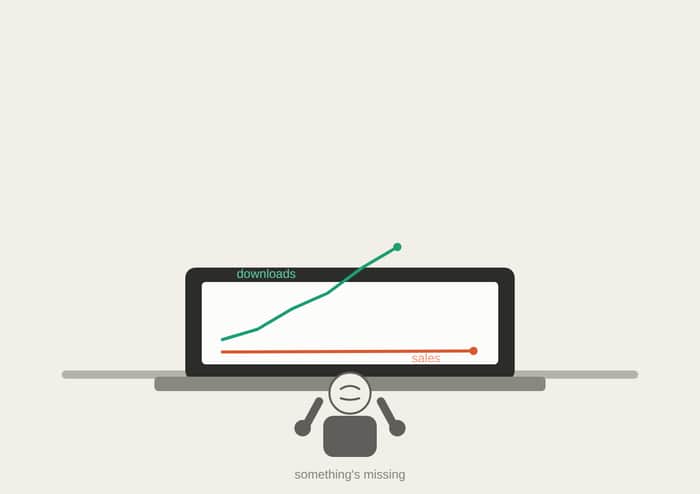
Follow-up to the "7 plugins, 328 downloads, $34.98" post from two weeks ago.
Downloads roughly doubled since then — 641 across 7 plugins now. Sales didn't move. Still 2 sales, still $34.98, same two plugins (Reading Inbox and Literature Review) that sold before.
Here's the breakdown by plugin, sorted by downloads:
AI Journal Coach — 153 downloads, 0 sales
Literature Review Synthesizer — 135 downloads, 1 sale
Highlight Inbox Synthesizer — 81 downloads, 0 sales
Meeting Notes Synthesizer — 80 downloads, 0 sales
Reading Inbox Synthesizer — 79 downloads, 1 sale
Watch Later Synthesizer — 75 downloads, 0 sales
Periodic Notes Synthesizer — 38 downloads, 0 sales
The pattern from last time held: the plugin with the most downloads (AI Journal Coach, 153) has zero sales. The two that sold are mid-pack on downloads. A commenter last time called this painkiller vs. vitamin — tools that process a backlog you already feel bad about (unread articles, unwatched videos) vs. tools that process your own output (journal entries, meeting notes). I bought that framing, and I still think it's directionally right. But it doesn't fully explain a 2x download jump with zero sales movement.
Where I'm stuck: I don't know if this is (a) a volume problem — 641 downloads is still too small a sample to expect more than 2 conversions at whatever this category's true rate is, (b) a positioning problem — even the backlog plugins aren't making the "why pay" case clearly enough at the free-tier-exhausted moment, or (c) something about the free tier itself (3 uses, lifetime) that's wrong in a way I can't see from the outside.
Genuinely asking, not fishing for reassurance: if you've shipped something similar — free tier + one-time paid upgrade, no subscription — what actually moved your conversion number? Was it volume, positioning, pricing, or something else entirely?

Some of us are pure beginners so am very lost but got some insight thanks
Same here, already learnt alot.
Stay strong were in it together
I tell you
Glad it was useful, even in the lost-beginner state — that's honestly the most honest place to read a post like this from.
0.3% download→paid on cold installs with no relationship isn't far off normal, so I'd rule out (c) before touching pricing or copy. The one thing I'd instrument first: what % of downloaders ever actually hit the 3-use wall? My bet is most never do.
Journaling especially (AI Journal Coach, your most-downloaded / zero-sale one) is aspirational — people install it intending to become a journaler, use it once or twice, and never build the backlog that would make them feel the pain. No wall hit = no reason to pay, and from the outside that reads as a positioning problem when it's really an activation problem.
The two that sold (Reading Inbox, Literature Review) are exactly the ones where the backlog already exists on day one — the unread pile is just sitting there, so users hit the wall fast. That's the painkiller/vitamin thing, but the actionable version is: does your free tier get people to the paid moment while the pain is hot? If a big chunk abandon before use 3, the lever isn't price, it's getting them to the wall faster — onboard them against their real backlog, not a demo run.
So before A/B testing price points I'd add one event: "hit free-tier limit," and look at what fraction of each plugin's downloaders ever fire it. That single number tells you whether you have a pricing problem or an activation problem, and they need completely different fixes.
This thread is gold. The 'activation vs downloads' framing is exactly right — and it points to a deeper problem most tools don't solve: knowing which specific features or moments actually drive the behaviour change that leads to payment.
641 downloads gives you noise. What you actually need is: which of those 641 users hit the exact feature that created the 'aha' moment — and how many times before they converted.
That's the gap I'm building Featly to close — not just tracking what users click, but surfacing which features correlate with the outcomes that actually matter, like conversion and retention. In plain English, without having to dig through dashboards.
My first instinct is that 641 downloads isn't the problem it's that people haven't experienced the "aha" moment before hitting the paywall. If users don't feel a meaningful improvement within those first 3 uses, more traffic alone probably won't fix conversions. Have you considered asking the two paying customers what convinced them to upgrade? Their answers might be more valuable than analyzing the non-buyers.
Already reached out to both buyers actually — sent about 2 days ago, no reply yet. Will share if that changes. In the meantime the "aha moment before the wall" framing matches what another commenter here just pointed out about AI Journal Coach specifically — worth checking whether people even reach use #3 before assuming it's a positioning problem.
That's a good point. I think "time to first value" is probably more important than the number of free uses. If someone gets the benefit on their first try, the paywall feels like a continuation. If they're still figuring the product out by use #3, it feels like an interruption.
Downloads show acquisition, but two sales say the value boundary is still unclear. I would compare each acquisition source by activation, repeated use, and willingness to pay. The useful question is not why people downloaded; it is what the two buyers did or understood that the other 639 did not.
Fair framing. That's actually the exact gap I'm about to close — adding a local "hit the free-tier wall" counter so I can see what the two buyers did differently from the other 639, instead of guessing from download numbers alone.
That counter measures the conversion boundary, which is much more useful than another download metric. Split it into people who hit the wall once vs repeatedly, then track time from first wall hit to purchase. That will tell you whether the limit reveals value or just interrupts it.
Both good refinements. Sobrica_HQ — agreed, and it's testable with what I'm already adding: firstLimitHitDate vs. install date tells me roughly how fast people got there. agentisland — the "once vs. repeatedly" split is the piece I was missing. Wall-hit count already covers repetition, but I hadn't planned to connect first-hit-to-purchase timing. Since Pro activation is already a timestamped event on my end, that's a cheap addition — will fold it in.
That cheap timestamp join is enough for the first pass. Keep the wall copy and limit unchanged, then compare purchase after first hit versus repeated hits; otherwise the instrumentation ships alongside a new confounder.
From what I've seen work in similar setups (free tier + one-time paid unlock, no subscription):
Usage-based limits that reset (daily/monthly) convert better than lifetime caps, because the user hits the wall repeatedly instead of once — repetition is what creates urgency, not scarcity
The wall itself matters more than the number — 3 vs 10 uses barely moves conversion; what happens when you hit the wall (a jarring dead-end vs. a clear "here's exactly what you get for $X") moves it a lot
Positioning the paid tier as "unlock forever" vs "remove limit" — framing it as ownership rather than a fee removes friction for people allergic to subscriptions
The "wall itself matters more than the number" point lines up with something another commenter raised earlier (recurring allowance vs. lifetime cap) — noted as a real candidate, but not testing it yet. Want to get actual wall-hit-rate data first before changing the mechanism itself; right now I'm flying blind on whether anyone even reaches the wall.
the split is your answer, not noise. the plugins with lots of downloads and zero sales like journal coach are curiosity / nice-to-have. the two that actually sell, literature review and reading inbox, solve a painful recurring task someone will pay to stop doing. so stop spreading across 7 and go deep on those two. and to find the why fast: message the 2 people who paid and 5 who downloaded journal coach but didnt, ask what job they were trying to do. youll have your answer in a day.
That's a concrete version of the buyer-conversation idea I keep saying I'll do — messaging the 5 who downloaded but didn't buy, not just the 2 who did, to see if there's a shared "job" they were trying to do. Hadn't thought to interview the non-converters specifically, only the converters. Adding both sides to the list.
That conversion rate is brutal — 641 downloads is solid traffic, so the problem is almost certainly happening after download. Have you looked at your day-1 retention or onboarding flow? Sometimes it's not the product, it's the "so what now?" moment.
Haven't looked at day-1 retention specifically — only have the aggregate download and sales numbers, nothing about what happens between install and either abandonment or purchase. That gap keeps coming up in this thread from different angles and I don't have an excuse for not having looked yet.
One buyer interview question that tends to beat "why did you buy?": "What were you trying to finish in the 30 minutes before you upgraded?"
Then map each plugin to whether it creates that same urgent task state before the paywall. If a plugin only sells a future-self benefit, I would test either a later free limit or onboarding that imports a real backlog first, because the paywall needs to appear while the pain is hot.
"What were you trying to finish in the 30 minutes before you upgraded" is a better question than anything I had planned to ask — it's specific enough to get an actual answer instead of a rationalized one. Stealing it for the buyer conversation. The plugin-by-plugin urgency mapping is useful too; I'd bet Journal Coach and Meeting Notes both fail it (no equivalent of "a real backlog that's already overdue"), which would explain the zero sales without needing a pricing or copy explanation at all.
The volume-vs-positioning question is actually cheap to answer: track how many of the 641 downloads hit the 3-use wall versus how many installed the plugin and never opened it again. If most people never exhaust the free tier, you don't have a pricing or positioning problem yet, you have an activation problem, and no amount of paywall copy will move the needle until more people actually reach it. I'd also go talk to the two people who paid and ask what specific moment triggered the purchase - a deadline, a specific note, a backlog that finally felt unmanageable - because that trigger is probably replicable in the other five plugins with different messaging, not different pricing. With only 2 conversions you genuinely can't separate (a) from (b) from (c) yet, so I'd resist redesigning anything until you have a cohort of at least 10-15 to look at. Have you instrumented the free-tier-exhausted event itself, or is the only signal you have right now the paywall trigger?
honestly i'd stop guessing from the dashboard and go talk to the 2 people who paid. two conversations will tell you more than another 600 downloads. ask them what they'd have lost if they hadn't upgraded. my bet is it's not volume - it's that the "why pay now" moment isn't sharp enough. the backlog plugins sold because the pain is already sitting there unread, guilt is a great closer. the output tools don't have that built-in urgency
Measure conversion from the moment someone exhausts the 3 free uses, not from downloads. If only a small fraction of the 641 ever hit that wall, you have an activation problem, and no pricing or positioning change will show up in sales. We hit the same thing at SocialPost.ai: most free users never reached the limit that triggered the paywall, and fixing that single step moved conversion more than everything else combined.
This is such a valuable breakdown — 641 downloads with 2 sales is the kind of data most founders never share publicly. The painkiller vs vitamin framing has been mentioned by several commenters, but I want to add a different angle: your 3-use lifetime cap might be actively preventing the habit formation that leads to purchase. For backlog tools like Reading Inbox, the value compounds each time you clear it — but with only 3 lifetime uses, the user never gets to experience that compounding relief. A weekly recurring limit instead of a lifetime cap would let users feel the value repeatedly, and each time they run out mid-backlog-clearing, the paywall hits at peak pain. Also plus one on interviewing your 2 buyers — even 2 data points about the exact moment of purchase will tell you more than 500 more downloads ever could.
This is a fascinating breakdown. The painkiller vs. vitamin framing is solid, but you might be onto something else too: friction at the decision moment.
At 641 downloads, 2 sales (0.3% conversion) might actually be normal for one-time paid indie plugins. The real question is: when someone hits the free tier limit, are they converting from "stuck" to "willing to pay" or just switching to a different tool?
Your two selling plugins (Reading Inbox, Literature Review) solve a specific pain that's already acute, you feel the backlog. But with AI Journal Coach at 153 downloads and zero sales, I wonder if the pain isn't acute enough at the moment someone hits the limit. They write a journal entry, hit the 3-use cap, and think "eh, I'll just write without AI today" instead of "I need this."
Have you tracked: when people hit the free limit, do they bounce immediately or do they come back? And for the ones that sell, how long between first use and purchase?
My hunch: it's not volume or positioning, it's that the buying moment is disconnected from the pain moment. You might need to make the friction of hitting the limit the moment where the pain is most obvious.
Either way, 641 downloads is real traction.
Haven't tracked either of those, no — don't know if people bounce immediately at the limit or come back later, and don't know the gap between first use and purchase for the two who bought. Both are things I could actually find out from the two-buyer conversation I keep saying I'll have, so that's now a concrete question to ask rather than a vague "why'd you buy." Your "pain moment disconnected from buying moment" framing is close to what a couple of others here landed on too — seems like the strongest read so far.
This resonates: the download-to-purchase gap is brutal for paid Mac apps. A few things that helped me think about it:
Have you narrowed down who your ideal customer is yet? That changed everything for my perspective on pricing vs. positioning.
Haven't narrowed the ideal customer beyond "someone with an existing backlog of a specific kind" (unread articles, research notes) — which the two that sold fit and the five that didn't, don't. Haven't gone narrower than that within those categories. Your Mac-specific points (clear value in 10 seconds, trial vs. hard cap) are useful even outside the Mac context — the 10-second clarity one especially, since I haven't audited whether the value prop is obvious immediately or only after reading three paragraphs.
Really appreciate you digging into this instead of giving a generic answer. The 10-second clarity point hits home; I think that's the gap for a lot of us building 'quiet utility' tools: the value is obvious once you're using it, but the landing page has to do all the convincing before that happens. Going to go audit my own homepage with that lens today.
Solid follow-up, İbrahim — love the transparency and the data breakdown. Doubling downloads with zero sales movement is frustrating but super valuable to see in public.
The painkiller vs vitamin framing still seems strong, especially with the sunk-cost layer on top (backlogs people already feel guilty about convert way better). My guess is it’s mostly a positioning/upgrade-moment issue rather than pure volume at this stage.
A couple of things that helped me in similar situations:
Reach out to your 2 buyers and ask what exactly pushed them over the edge (timing, specific pain, wording, etc.). Those two people know more than the 639 non-buyers.
Test making the free tier trigger the paywall at the moment of maximum relief (e.g. right after they process a big backlog) instead of a hard 3-use lifetime cap.
Keep shipping and iterating — this kind of consistent posting is how you build an audience that eventually buys. Rooting for the next update to show more sales!
Hey — built a marketplace for buying/selling AI agent businesses. Free premium listing at launch for early sellers. Check it out: agentalm.com
641 downloads across 7 plugins is roughly 90 each, so you're testing 7 positioning hypotheses with sample sizes too small to read. I'd ignore the bottom five and put everything into the two that converted, the market already voted. Also, 3 lifetime free uses probably expires before the habit forms: paywalls convert at the moment of felt value, and for backlog tools that moment is the second or third weekly clear-out, not use number four.
I’d separate “download intent” from “upgrade intent” here. A download only shows curiosity; the paid moment probably comes when the user hits a specific backlog and thinks, “I need this finished now.”
The two plugins that sold both seem to lift a pile of guilt, unread articles, research backlog. I’d test a couple of changes before tweaking the price: give each plugin its own “when this pays for itself” line instead of just a feature blurb, and move the upgrade prompt to right after a useful first result, with a concrete next step like “Process the remaining 47 notes.” Then compare conversion by plugin category rather than lumping all downloads together.
Sure, 641 downloads is still a small sample, but the real question is which plugin creates urgency before the free tier runs out?
"Download intent vs. upgrade intent" is a cleaner split than the one I've been using. The concrete next-step idea ("Process the remaining 47 notes") is specific in a way my current copy isn't — it names the actual thing being lost, not just a category of it. Going to try that phrasing on the plugin I already touched before rolling it anywhere else.
Exactly, the actual thing being lost is the part that usually changes the decision. I'd test it as close to the action as possible: not “upgrade to process more notes,” but something like “Process the remaining 47 notes” right when they hit the limit. Curious if the plugin you already touched shows any signal from that change. Even a small lift there would tell you the problem is copy/framing, not the whole product.
The download-to-sale conversion challenge is real. From my experience with AI tools, the gap often comes down to onboarding friction - users download but don't hit that first 'aha moment'. What's your activation rate like? Sometimes optimizing the first 5 minutes of user experience matters more than the product itself.
This comment was deleted 2 months ago
I think you're focusing on the conversion rate, but the more interesting signal is that 641 people downloaded something from you and almost nobody asked for a refund or complained. That suggests the problem isn't trust or product quality.
My guess is that most users haven't reached a strong enough pain point yet. A download is curiosity. A purchase is urgency.
If I were you, I'd spend less time testing pricing and more time understanding the exact moment when someone thinks: "I don't want to do this manually anymore." Then make your paywall and messaging revolve around that moment.
Also, I'd definitely interview the 2 buyers before changing anything major. Two paying customers may sound insignificant, but they contain 100% of your revenue data. Their reasons for buying are probably worth more than another 500 downloads.
the volume worry is a bit of a distraction imo. 2 out of 641 doesn't reveal your true rate, but the shape of the data already does: the two that convert are the backlog tools people feel guilty about. that's the signal. you're spreading yourself across 7 when the data is telling you which 2 have any pull.
i'd bet it's (c) wearing a (b) costume. '3 uses lifetime' drops the paywall at an arbitrary spot instead of the moment the value actually lands. for a backlog tool that moment is when the pile is huge and you just made it vanish, not on use #4. a lifetime cap also quietly frames the thing as a one-time job, and one-time jobs are brutal to charge for, once it's done there's no reason to come back or pay.
what actually moved my numbers wasn't more traffic, it was gating on outcome instead of a use counter, and picking the one tool with a recurring reason to reopen. a reading inbox refills every week, a journal coach is basically one-and-done for most people. go where there's a natural cadence and put the paywall at peak relief, not peak use count.
This resonates — just launched my own first side project this week and going through the same "did people actually get it or did they just bounce" feeling. Following this thread, curious what you find out. Did you get any direct feedback from the 2 who converted, or just silence?
Honestly, silence so far — I haven't reached out yet, which a few people in this thread have fairly called out. Doing it this week. Will post back with whatever I find, good or bad.
The cleanest part of our 2-buyer dataset wasn't the number, it was WHAT they said when we asked why they paid. Neither trigger was a product feature — both were about the moment: one paid because a live experiment was 9 minutes from failing and he could be the ending, the other because his advice had just been implemented in front of him. No landing page could have contained either sentence. That's what made me stop treating positioning as copy and start treating it as timing: the same product converts when the buyer can see their own action mattering RIGHT NOW.
If you ever interview your two buyers, I'd genuinely like to know if you find the same shape — a moment, not a feature.
That's exactly the kind of thing I was hoping talking to buyers would surface, and you already have it: a moment, not a feature. "9 minutes from a live experiment failing" and "advice just got implemented in front of him" are both about the buyer watching their own action have a consequence right then, not about anything on a landing page. I hadn't separated timing from positioning as cleanly as you just did. Reaching out to my two this week — I'll report back whether I find the same shape.
The volume/revenue gap is brutal. 641 downloads is solid distribution, but 2 sales suggests a messaging or positioning issue more than a product one. Have you tried segmenting your users - like, which countries/device types are downloading vs. which ones are converting? Sometimes the gap isn't about getting more downloads, it's about finding the 10% who actually value what you built.
I haven't segmented by country or device, no — that's a real gap, I've only been looking at aggregate Gumroad numbers. Will check what's actually available there and see if a pattern shows up. Appreciate the reframe: "more downloads" and "find the 10% who value it" are different problems and I've mostly been treating them as the same one.
Before touching pricing or positioning, the number I'd want is: of the 641, how many actually reached use #3 and hit the wall? Downloads is the wrong denominator. Your real conversion rate is paid divided by people who exhausted the free tier, and my bet is most of the 641 tried it once and drifted, so the "why pay" moment never even fired. If that's the case, this is an activation problem wearing a conversion problem's clothes.
The 3-uses-lifetime tier is probably working against you. For backlog tools the value compounds through a habit, and a lifetime cap that small kills the habit before it forms. People hit the wall as curious triers, not as attached users, so they churn instead of paying. Counterintuitively a more generous recurring limit (say N a week) often converts better than a tiny lifetime one, because the limit bites over and over at a moment of real need instead of once, early, before they care.
On painkiller vs vitamin, I'd sharpen it to recurring guilt vs one-time nicety. Reading Inbox and Literature Review map to a backlog that refills and nags you every week. AI Journal Coach processes your own output, and a lot of people who install it don't have a painful pile yet, so there's nothing to relieve. Most-downloaded just means best title; sales follow felt pain, not curiosity.
For context, I'm the founder of Automateed (freemium AI tool with a paid upgrade, plus a marketplace), so I've stared at this exact curve. The one change that actually moved our number wasn't price or landing-page copy, it was making the paywall fire after the user had already produced an output they wanted to keep, and making the free tier generous enough to reliably reach that moment. Before that aha, every upgrade button is just noise. At 641 downloads with a lifetime free cap, I'd fix the moment before I'd touch the price.
This is a genuinely useful reframe — "denominator should be people who hit the wall, not total downloads" is a number I don't have and should. And the recurring-limit point landed: I actually started a small experiment today, before reading this, raising one plugin's free tier from 3 lifetime uses to 10 lifetime — still a lifetime cap, not recurring, mostly because I don't want to build usage tracking (no telemetry is a hard line here). But your point about the paywall firing after the user already has something they want to keep, rather than as an arbitrary count, is the sharper lever and I don't think 10-vs-3 addresses it at all. Noting it as a real candidate for the next iteration if the lifetime-cap bump doesn't move anything.
I'm having some trouble getting my product out there as well. Currently at a place where I just want people to try it, not even pay for it.
I honestly think it's still too early to read too much into the numbers. 641 downloads sounds like a lot, but with only 2 sales the sample is still tiny.
One thing I did notice though is the free tier. If I get 3 lifetime uses, there's a decent chance I never actually hit the limit. I'd try it, think "nice tool," and then not touch it again for weeks. In that case I'm never even given a reason to buy.
I'd be more interested in seeing how many people came back and used a plugin a second or third time. Feels like that would tell you way more than total downloads.
Just my 2 cents, but I'd probably focus on getting people to come back before changing the pricing. The pricing might not even be the real issue.
That's the same shape a couple of others in this thread landed on independently, and I think you're right that it matters more than the download total does. I don't have return-usage data broken out right now — it's on the list to go dig up. Appreciate the steer toward fixing return behavior before touching price; that's probably the correct order and I had it backwards.
Small dataset from a different corner, but it changed how I read numbers like yours: we sell a dev playbook with a pay-what-you-want tier, and 100% of the revenue came from direct conversations — replies to specific people who were already engaged — while broadcast posts with 10x the impressions produced exactly zero. Downloads/views never predicted anything; the only variable that ever moved money was whether a real exchange happened first.
So on your (a)/(b)/(c): I'd bet on a fourth option — the 641 downloads aren't a funnel, they're an audience. A 3-use lifetime free tier means people hit the paywall alone at their desk, with no conversation running. Have you tried talking to the 2 buyers instead of the 639 non-buyers? Both of ours told us the exact sentence that made them pay, and it wasn't anything we had written on the landing page.
That downloads-vs-conversation split matches something I've seen too, just from a different angle: every push channel I've tried (social, forum posts, Product Hunt) has converted at roughly 0%, while the only real signal has come from passive/organic discovery. I hadn't framed it as "broadcast vs. direct exchange" before, but that's a sharper way to say it than "push vs. pull." Appreciate the number — 100% from direct conversation on a pay-what-you-want tier is a much cleaner signal than my 2-sales dataset can give me right now.
My honest read leans toward (b) over (a). I run a free audit tool as the entry point into my own paid work, and the pattern that took me the longest to see was that people will use a free tool that solves an immediate, nameable problem without ever connecting it to the paid step, because the free tool already made them feel done. Reading Inbox and Literature Review sold because they process a backlog someone already feels guilty about, and hitting the free tier ceiling on that specific guilt is a sharper moment than hitting a usage cap on a journal tool nobody was dreading in the first place.
I'd push on your free tier itself before touching pricing. Three uses, lifetime, is a hard wall with no visible edge to it while someone's using the tool. The conversion moment that actually works is usually mid task, not after the door's already closed, something closer to a visible counter ticking down so the person feels the wall coming before they hit it. That's a positioning problem wearing a volume problem's clothes.
I wouldn't rule out volume yet either. Two sales at 641 is thin enough that you genuinely can't separate signal from noise. I'd want to see this at two or three thousand downloads before trusting any conclusion about which framing is right.
Agreed on all three points, and the third one is the one I keep underweighting — assuming the free-tier ceiling IS the trigger, rather than checking whether it's just when the tool became habitual. I don't have telemetry to tell those apart (won't add tracking here), so the only honest move I have is asking the people who converted directly what was actually happening for them at the time, rather than reverse-engineering it from usage numbers alone.
This mirrors something I learned the hard way: the obvious answer usually has a non-obvious cost that only shows up six months later. Worth naming it early.
That's a useful frame, thanks. I don't have a six-month-out cost I'm bracing for yet, but the closest thing might be the free tier itself — if I raise it and it turns out the real issue was never volume, I'll have spent effort optimizing the wrong knob while the actual answer (category, or something about how the paywall moment is framed) sits untouched. Naming it early, per your suggestion: I'll treat a flat conversion rate after the free-tier bump as a signal to stop tuning the number and go talk to the two people who bought instead of guessing further.
One thing that might help: if you're using Stripe (or something similar) to charge, you likely have the email of those 2 people who paid. Try reaching out directly and just ask what made them decide to buy vs. everyone else who just downloaded. A 5-minute conversation with an actual paying user usually reveals more than any amount of guessing from the data alone.
This is a great kind of post to see — real numbers and honest uncertainty. Have you looked at where the 2 paying users came from? Sometimes the pattern between who converts vs. who just downloads gives a clue for repositioning.
Yes on both counts — I do have their emails from the purchase, and no, I haven't reached out yet, which several people here have now (fairly) called out. Doing it this week. Your second point is the one I want the answer to more: whether there's a pattern in what those two were doing before they bought, since that's the thing that would actually tell me something about repositioning rather than just confirming I should talk to people (which, yes, obviously).
That's an interesting issue you've run into. One thing that is helping me (in a very similar situation) has been tracking usage and seeing falloff there.
I recently had an issue with DeerDawn where I was getting signups but no payments, and not even any real change in api costs. I added posthog tracking for key things, mcp calls, context shared, and whatnot and found that most people who made an account weren't even completing onboarding.
This observation allowed me to go through the onboarding process and look at where people were getting stuck, and what was just taking too long. (I was making people open their terminal to complete onboarding, I changed that to pasting a custom mcp connect to claude or chatgpt and completion improved)
Best of luck!
You and a couple others below are converging on the same point and I don't have a good excuse for not having done it yet — I haven't talked to the 2 people who actually paid. I've been treating this as a data problem (limit size, category, copy) when the fastest way to actually find out is just asking the two humans who made the decision. Going to reach out to both this week and report back honestly, including if the answer turns out boring or unflattering to my current theories.
I had the same exact issue when I was working through my onboarding process. All the data in the world is worth less than just hearing what people think. End of the day knowing that and adjusting based off it will get you way further, way faster. Best of luck!
I wonder if the downloads are telling you one thing and the sales another.
Someone downloading a plugin is a very low-commitment action. Buying it requires trusting that it will become part of their workflow.
If I were in your position, I'd spend some time talking to the two customers who did buy. Understanding why they paid might be more valuable than trying to guess why the other 639 didn't.
Sometimes the buyers reveal your real positioning better than the non-buyers.
That's a clean way to put the asymmetry — download is basically free to do, purchase requires believing the tool earns a permanent spot in your workflow. I've been reading the download number as if it validated the idea, when it might only validate the pitch. Talking to the two buyers is the next step, agreed — seems to be the one thing everyone in this thread landed on independently, which is probably a signal in itself.
If that's true, I'd spend less time asking why people aren't converting and more time asking what changes in the moment someone decides, "I can't keep doing this manually." That transition may reveal more than another few hundred downloads ever will.
This comment was deleted 2 months ago
The 0.3% conversion on 641 downloads points most strongly to your option (b) — positioning at the moment of free-tier exhaustion. That moment is your entire sales pitch and most tools blow it with a generic 'upgrade to unlock more' wall. The people who hit the 3-use limit and don't pay aren't saying the product is bad. They're saying the value isn't clear enough at that exact moment to justify spending money. What happens right now when someone hits their limit? Is there a message that articulates specifically what they're losing, or is it just a paywall? Changing that one screen has moved conversion numbers more for me than any other single change.
This is a sharp read and I think you're right. I went back and looked at what the free-tier-exhausted screen actually says across all 7 plugins, and it's the generic version of exactly what you're describing: "Free limit reached" + a short explanation + a "Get Pro license" button. It never tells the person what they specifically just lost access to.
Concretely, for a synthesis plugin that means the screen could say something like "3 more articles are waiting to be synthesized" instead of a flat limit notice — the cost of not upgrading becomes a specific, visible thing instead of an abstract wall. I hadn't separated "the limit exists" from "how the limit is communicated" as two different problems until you framed it this way — I'd been treating low conversion as a category problem (backlog vs. own-archive tools) and hadn't isolated the paywall-copy variable at all.
I'll try rewriting that screen with capsule-specific language and see if it moves anything. Appreciate you laying out the reasoning instead of just dropping a conclusion.
The way you split it into volume vs positioning vs the free tier is sharper than most people get to, and "wrong in a way I can't see from the outside" is exactly the trap at this size. Honestly the two people who already paid are the only ones who can collapse that ambiguity for you right now. Have you been able to ask either of them what specifically pushed them from the free uses to the $19.99, or is it still just the two sales with no why attached?
Interesting breakdown. I think the point about "painkiller vs vitamin" is really important.
I'm also facing a similar challenge with my AI marketing tool. Building the product was much easier than finding the first users.
From my experience so far, I'm starting to think positioning matters a lot. A tool can be useful, but if the user doesn't immediately feel "I need this because it solves a problem I have right now", conversions are hard.
I'm curious about one thing: have you tried talking directly with the people who downloaded but didn't buy? That might reveal whether the issue is pricing, the free plan, or simply not enough urgency.
641 downloads with 2 sales is enough to stop treating all downloads as equal.
I would split the plugins by intent: protecting a backlog the user already invested in, reflection/synthesis, and routine cleanup. Literature Review and Reading Inbox have explicit loss language — “I saved this and still cannot process it” — while Journal Coach is more curiosity-led.
Before changing price, I would test one loss-specific upgrade promise and ask five users who exhausted the free tier what they expected to happen next. The useful comparison is the wording people use after a failed manual workflow, not download volume alone.
This is the kind of community-demand clustering I am building DemandThread for. Happy to send three relevant source threads if useful.
The painkiller vs vitamin framing is right but I think there's a layer underneath it worth looking at.
The two that sold (Reading Inbox, Literature Review) have something in common beyond "backlog pain" — they process things the user already invested time collecting. Unread articles they saved on purpose. Research they gathered deliberately. There's sunk cost attached to that backlog which makes the pain more acute.
AI Journal Coach has 153 downloads and zero sales probably because journals feel personal and low-stakes. If the AI misses something in your journal entry, nothing bad happens. But if it misses something in your literature review, that's a real cost.
On your three hypotheses — I'd bet on positioning over volume. 641 downloads with 2 conversions at a 0.3% rate suggests the free tier is doing its job (getting people in) but the upgrade moment isn't landing. The question I'd ask is: what does the user see right at the moment they hit the free tier limit? That's your entire conversion argument in one screen and it's probably not specific enough about what they lose by not upgrading.
I'm two days into early access on a different kind of product so I don't have conversion data yet — but I'm watching this exact dynamic closely. Following to see how it develops.
The sunk-cost layer underneath painkiller/vitamin is a good addition — "you already invested effort collecting this" is a real difference between a saved-articles backlog and a journal entry, and it's not just about stakes, it's about what the person already put in before the plugin ever touched it. Explains why AI Journal Coach's downloads don't convert even though journaling itself isn't a low-stakes activity for a lot of people — the AI's mistake costs nothing because there was no prior investment for it to protect.
On the specific-screen question: fair, and it's exactly what I changed on one plugin already — the upgrade prompt used to just say "upgrade now," now it says what's specifically waiting (unsynced backlog). Too early to know if it moved anything.
I've been staring at almost the same numbers on my own build. What actually helped was breaking 'downloads' into where they came from instead of treating it as one bucket, once I saw how much was direct with no referrer at all, the 'bad landing page' theory stopped holding up, it just meant nobody outside people who already knew about it were finding it. Worth checking if your 641 has that same shape before you start rewriting the pricing or the page, a distribution problem and a conversion problem look identical in the top line number but need completely different fixes.
Haven't broken it down by referrer, no — that's a real gap in what I've been looking at. Going to go check whether the 641 skews direct/no-referrer or whether there's an actual traffic source behind it, since you're right that it changes which problem I'm actually looking at.
The gap I'd want to close first: you can see both ends of the funnel (641 downloads, 2 sales) but nothing in the middle. Downloads, installs that actually ran, users who hit the 3-use limit, paywall views, purchases. Your (a), (b) and (c) are three different leaks in that pipe, and they're indistinguishable right now because you only have counters at the two ends.
I build monitoring systems for a living, so take this as professional bias, but: before touching pricing or positioning, I'd add one local counter for "user exhausted the free tier". No remote telemetry needed, just count locally and surface it at the paywall moment. If 90% of installs never reach use #3, it's an activation problem and no amount of repositioning will move sales. If plenty of people hit the wall and still walk away, then the "why pay" case is the real suspect. One cheap number turns two more weeks of guessing into a decision.
A local-only counter for "hit the wall" is a good middle ground I hadn't considered — it answers exactly the activation-vs-conversion split without needing any remote telemetry, which is the line I don't want to cross. Worth doing regardless of what else changes, since right now I genuinely can't tell those two failure modes apart. Adding it to the list.
"This 'painkiller vs vitamin' distinction is gold. I'm about to launch a tool for freelancers that calculates their REAL hourly profitability — and the 'pain' is exactly what you described: people think they're 'busy and successful' until they see they're earning €8/hour.
Your insight about the 3-use free limit killing enthusiasm before value is realized is critical. I'm designing my onboarding right now — would you say a time-based trial (7 days) converts better than a usage-based one (3 uses) for data-processing tools?
Also: have you considered reaching out to your 2 paying customers with a simple 'what almost stopped you from buying?' email? That single question has saved me weeks of guessing in past projects."
Honestly don't know yet — haven't tested either against this specific case. My guess, for what it's worth: usage-based probably fits better for tools where the value only shows up after real content exists (a backlog gets processed, a report gets generated), since a 7-day clock can run out before someone's actually fed the tool anything. But that's a guess, not a result. And yes to the buyer email — several people here have pushed me toward exactly that, sending it this week.
Thanks for the detailed reply! That makes total sense — for data-processing tools, the 'aha moment' happens AFTER the first use, not during a time window. I'm designing my onboarding so the value hits immediately (upload CSV → 30s report). No trial needed, the demo IS the trial.
Would love to hear what your 2 paying customers say — especially what 'almost stopped them from buying.' That's usually the goldmine insight
I run a free-preview to one-time-paid product too (no sub), so this is the exact number I stared at for a while. three things that moved mine, in order of impact:
the moment of the ask beat everything. conversions came from making the free tier deliver its aha on the user's own data, then hitting the wall right at peak "oh this is useful" — not X uses later. your "3 uses, lifetime" might be spending the aha before it lands: for output-processing tools the first run or two is often just the user figuring out what it does, so the value moment arrives exactly when they're out of free uses and already gone. worth testing a time-boxed free tier (e.g. 7 days unlimited) vs 3-lifetime.
position per plugin, not per suite. AI Journal Coach at 153 dl / 0 sales vs the backlog ones selling says the painkiller/vitamin read is right — stop treating them as one funnel, let the two that convert carry the messaging, de-prioritize the vitamins.
volume genuinely is still low. 2 sales on 641 isn't enough to diagnose pricing — I wouldn't touch price until a converting plugin has ~2-3k downloads. right now you're reading noise.
for context I'm building LeadGrid (verified local-biz lead lists, free 5-row preview then pay-per-list) plus a couple of consumer apps, all on this same free-to-one-time model, and "preview shows your own data" was the single biggest conversion lever across all of them. happy to compare notes.
All three land, but #1 is the one I hadn't separated out before: "the aha moment might arrive before the free uses run out" is a different claim than "3 is too few," and I'd been treating them as the same thing. A time-boxed trial would test that directly in a way raising the count to 10 doesn't — 10 still assumes the wall itself is the right mechanism, just needs to be further away.
On #2, already doing that — stopped touching the vitamin plugins' pricing/limits and I'm only experimenting on the two that convert. On #3, agreed, and it's part of why I'm not planning to touch price at all right now, just the free-tier mechanism and the upgrade copy.
Would take you up on comparing notes — "preview shows your own data" as the single biggest lever matches what I'd guess for these too, just haven't tested a preview-based gate yet.
the thing that made preview-as-gate work for me wasn't the preview, it was WHERE it cuts. show enough of their real output to prove it worked, then stop exactly at the point where finishing by hand is obviously more painful than paying. the pain has to be visible in the result, not described in copy.
mapped to your two converters: Reading Inbox and Literature Review both already have the user's real backlog loaded on day one, so a preview that synthesizes their first few unread items and then gates "process the remaining 74" is a much hotter moment than a use-counter — the unfinished pile is right there. Journal Coach can't do that because there's no backlog to preview yet, which is the same activation gap you flagged.
one thing that cost me a month: the preview only converts if it runs on THEIR data. a demo/sample preview converted about the same as no preview at all — people discount it because it's not their mess. so if you test a preview gate, make it operate on the file they just connected, not a canned example.
you're in a better spot to A/B this than i was since you've already got two plugins that convert — i'd run preview-gate vs 7-day-trial on just those two and leave the vitamins alone. genuinely keen to hear which wins, ping me either way.
The "has to run on their real data, not a canned example" point is the part I'd have gotten wrong if I tried this blind — makes sense in hindsight (a demo output proves the tool works, not that it's worth paying for your specific pile), but I wouldn't have predicted it costing a month to learn. Useful to have it in advance.
And the mapping to Journal Coach is exactly right — no backlog to preview against means no version of this gate is available to it at all, same activation gap as before, just showing up in a different mechanism now.
Going to think about running preview-gate vs. the 10-lifetime-count version already live on Reading Inbox, rather than adding a third variant — comparing against what's already shipped instead of stacking another change on top. Appreciate the offer to compare notes, will take you up on it once there's something real to compare.
perfect. one thing that'll save you a week: lock the success metric before you flip the gate on. i kept sliding between "more trials started" and "more paid" halfway through my own test and ended up unable to read it. for reading inbox i'd watch trial-to-paid specifically, not trial count — a preview gate usually pulls fewer trials that convert better, so a lower number there is the win, not a regression. ping me when it's got real data, genuinely want to see which way it breaks. happy to trade you the numbers from the same gate on the lead tool so it's not a one-way street.
For me, the first impression is that your price is too high. Downloading to look at it is not a problem; paying more than $ 15 for something is quite a decision.
Fair, and worth saying plainly: it's $19.99 for most of these, one time, no subscription. Doesn't make the decision smaller, just wanted the actual number on the table rather than "$15+."
I’m still very new to building products, so this is just an outside observation rather than advice based on experience.
To me, downloads doubling while sales stay flat suggests this may not be only a volume problem. Downloading is a low-cost action. It can mean “this looks interesting” without meaning “I have a painful enough problem to pay for this.”
The AI Journal Coach having the most downloads but zero sales seems consistent with that. It may attract curiosity, but processing journal entries may not feel urgent enough to pay for. Reading Inbox and Literature Review are closer to clearing an existing backlog, so the painkiller vs. vitamin framing still seems useful.
The most important missing data may be:
If most users never use all 3 free runs, pricing may not be the main issue. The product may simply not create enough repeated value. If many users hit the limit and still do not buy, then positioning, pricing, or the upgrade message becomes more likely.
The 3-use lifetime free tier may also sit in an awkward middle: too little to build trust for some users, but enough for people with only occasional needs.
I would probably test one plugin first, maybe Reading Inbox, and change only the free limit or upgrade message there. That seems easier to learn from than trying to increase downloads across all seven.
That's exactly what I did — changed the limit and the upgrade copy on Reading Inbox only, left the other six untouched. Appreciate the confirmation that testing one at a time is the right call rather than trying to fix everything at once.
The data breakdown is super interesting. It's tough seeing the AI Journal Coach pull the most downloads (153) but zero sales. That high download rate shows the hook is strong, but the drop-off might mean the value isn't hitting quickly enough during their first session. For plugins like Reading Inbox and Literature Review that actually converted, have you reached out to those 2 paying customers? Knowing exactly why they pulled out their wallets could give you the blueprint to fix the others
Not yet, still the honest answer. Reaching out this week — I know I've said that a few times in this thread now, so I'll actually post the outcome once I have it instead of saying it again.
The jump in downloads is awesome traction, but that stagnant conversion rate is brutal.
To answer your core question: from my experience shipping one-time paid products (and watching other founders struggle with this exact metric), the problem you're hitting right now is almost certainly (c) wearing a (b) costume.
Here is what I mean:
A "3 uses, lifetime" free tier doesn't drop the paywall at the moment of peak relief; it drops it at an arbitrary, mechanical limit.
For the "backlog/painkiller" plugins (Reading Inbox, Literature Review), the "aha" moment for the user isn't using it three times. The "aha" moment is watching a massive, guilt-inducing pile of unread tabs vanish into a clean, synthesized summary.
When you gate by a lifetime count, you are quietly framing the plugin as a one-off utility. And charging for a one-off utility is incredibly hard.
The data is already telling you what works. The backlog tools are the only ones with pull. Double down your energy on Reading Inbox and Literature Review, and stop worrying about why the Journal Coach isn't selling.
A reading inbox naturally refills every week. Instead of a 3-use lifetime limit, what if the free tier processed a limited size of the backlog (e.g., processes up to 10 links for free, pay to unlock unlimited batch processing)? That drops the paywall at the exact moment the user feels the pain of their massive backlog, rather than on arbitrary use #4.
Lastly, at 641 downloads, you are right, you don't have statistical significance. The only honest move right now is qualitative data. You have two buyers. They hold 100% of your revenue data. if you can, Get them on a quick 10-minute call or email exchange and find out the exact context of why they pulled out their credit card. Their answer is worth more than 1,000 more free downloads.
This is a genuinely different mechanism than anything else suggested here — gating on backlog size processed rather than on use-count. It maps naturally onto what these plugins already do (they already know how many items are in the pile), so it wouldn't need new tracking, just moving the gate to a number I already compute. Considering it as the next experiment after this one plays out.
The thing I'd flag: you're treating this as one conversion problem across 7 products, but your own numbers already answer it. The two that sold both clear a finite backlog, so "pay once" fits perfectly. AI Journal Coach has 153 downloads and 0 sales because a journaling tool only proves its value through repeated use, and a 3-use lifetime cap makes people hit the wall before the habit (and the value) exists. That's not weak positioning, it's a structural mismatch, and no paywall copy fixes it.
I just shipped an app with a free consumable that refills daily instead of a lifetime cap, specifically for this reason. A hard lifetime limit makes people ration and bounce before they're attached. A resetting allowance lets the habit form first, then the upgrade becomes "skip the wait, get more," which converts on impatience once they already care.
One more thing: with no telemetry you can't see how many of the 641 even hit the paywall, so "volume vs positioning vs pricing" isn't answerable from the outside. I'd pick your two best candidates, add a tiny local counter (or just DM every downloader you can reach), and watch exactly where people stop. At this size that's the only real signal.
Both fair, and the first one is something I'm acting on directly — Journal Coach was found to be on an actual monthly reset, not a true lifetime cap like the copy claimed, so "hitting the wall before the habit forms" was worse than I'd realized. Fixing that now: true lifetime count, raised to 10, plus a race-safe counter and concurrency guard that plugin didn't have either. On the telemetry point — agreed, and I'm not going to resolve that by adding tracking. The two-buyer conversation is the only way I have left to get real signal at this volume.
Nice, the monthly-reset bug is a good catch, that would've quietly skewed everything. Raising to 10 with a race-safe counter and concurrency guard is right regardless.
One thing to watch: you changed two variables at once, the cap (3 to 10) and the upgrade copy (generic to "here's your unsynced backlog"). So if conversion moves, you won't know which one did it. Not saying redo it, just that the next number is directional, not causal. If you had to bet, which of those two do you actually think is doing the work? Worth deciding now, before the results come in and you credit whichever you're more attached to.
On telemetry: fair enough, but a single local "times this user hit the wall" counter, aggregate and no PII, isn't really the tracking you're avoiding, and it's the one number that tells you whether 10 is right or whether nobody ever got near 3. Your call. Either way, respect for shipping the fix same day.
Fair point, and you're right that the copy principle is lower-risk than the count. But rolling it out everywhere now would mean I lose any clean control group — right now the other 6 plugins are effectively my baseline. If I change their copy too, I can't tell later whether Reading Inbox's result (whatever it turns out to be) had anything to do with copy at all, because there's no unchanged group left to compare against.
I'd rather wait for the single-variable follow-up test to actually tell me something, then roll out the winning lever with real evidence instead of a good guess. Appreciate you pushing on it though — it's a reasonable instinct, just want to keep the experiment clean a bit longer.
You're right and I should have caught this myself before shipping — I did change both the cap and the copy in the same release, so whatever happens next genuinely won't isolate which one did it. If I had to bet: the copy change is probably doing more of the work than the number, since "unsynced backlog keeps building" names a specific loss and 3-vs-10 is still just a bigger version of the same abstract wall. But that's a guess dressed up as a bet, not something I can back with data from this test as designed.
On the local counter — fair distinction, and you're right that a local "hit the wall" tally isn't the kind of tracking I've been ruling out. Going to add that before I run another variant, so the next change is actually a clean one-variable test instead of two confounded at once.
That bet sounds right to me, and for a good reason: "unsynced backlog keeps building" makes the pain concrete at the exact moment of the decision, while 3-vs-10 is just moving an abstract line. You're basically applying the painkiller framing to the paywall itself.
If you actually believe that's the lever, the useful move is to not wait to isolate it on this one plugin. The "name the specific loss" copy generalizes to all 7, each has its own concrete thing that piles up if someone stops. The cap number is fiddly and per-plugin, but the copy principle is one insight you can roll everywhere right now, low risk, high upside. Then your clean one-variable tests can be about tuning the number, which matters far less.
Either way, good discipline separating the guess from what the data can actually back. Most people would've just declared victory on whichever moved.
Update: the free-tier change I mentioned above is actually live now, not just planned. Reading Inbox Synthesizer went from 3 to 10 lifetime syncs, and the upgrade prompt now says what's specifically at stake (unsynced backlog) instead of a generic "upgrade now." Shipped as v1.1.1 today.
One thing a couple of you pointed out that I want to be upfront about: I don't know how many of the original 641 downloads actually hit the old 3-use wall. So if nothing changes after this, I won't be able to tell whether 10 is still the wrong number or whether most people never got close to 3 in the first place. Noted for next time — should have measured that before touching anything.
Will leave this running and report back with real numbers, not more theorizing.
The activation point others are making is right, but I'd push on your painkiller-vs-vitamin read from a different angle: the two plugins that sold (Reading Inbox, Literature Review) both clear a finite backlog. That's a great reason to pay once and a terrible reason to pay twice, because when the backlog is gone, so is the need. The vitamin plugins (Journal Coach, Meeting Notes) are the opposite. They would create repeat use if anyone stuck with them, but the value is diffuse, so nobody ever feels the ceiling. Neither shape is broken, they just fail at different steps, which is probably why one blended conversion number keeps confusing you.
If I could add one thing to your dashboard it wouldn't be more downloads, it'd be the percent of downloaders who run the plugin a second time. That single number tells you whether you have an activation problem (they never came back, so the paywall is irrelevant) or a monetization problem (they came back, hit the wall, and still passed). Right now you're staring at the two endpoints with the whole story hidden in the middle.
The thing that actually moved conversion for us when I was building Automateed (also free-to-paid): we stopped gating on an abstract use count and started gating on the finished result. Let people run the whole thing and see the output they made, then put the wall on keeping or exporting it. "3 uses, lifetime" asks someone to pay before they're attached to anything. People pay to not lose something they just watched come together far more than they pay for use number four.
Also worth saying: posting the ugly numbers instead of a win is the version of building in public that's actually useful. Respect for that.
The "gate on the finished result, not an abstract count" point is sharp and I think it's the actual lever, more than 3-vs-10 ever was. I raised the number to 10 as a smaller, reversible first step, but what you're describing — let people finish something and feel it, then charge to keep it — is a different kind of change and probably the right one long-term. Filing it away for the next iteration rather than the number tweak I already shipped.
My instinct is it's usually (b) more than people expect, not (a). 641 downloads for a niche knowledge-worker tool isn't actually a tiny sample if the value prop was clear at the point of download, low conversion after real usage is more often "the free tier never created a moment where the person felt the ceiling" than "not enough people tried it."
One thing I noticed while testing willingness-to-pay on a free tool of my own: the framing that moved people wasn't "this tool does X," it was naming the exact moment the free tier stops being enough, not "3 uses" as an abstract limit, but describing what happens on use 4. If someone downloads a tool, uses it once or twice, and forgets about it, they never even reach your paywall to feel friction from it.
I'd guess AI Journal Coach's 153 downloads and 0 sales versus your 2 converters is less about interest and more about whether the tool created any kind of repeat habit at all inside the free tier. Curious whether your 2 sales came from people who used the free tier heavily right up to the limit, or fairly lightly.
Honest answer: I don't know yet, since I haven't talked to either buyer. That's the exact gap several people in this thread have called out and I'm closing this week. Will post the real answer once I have it — heavy usage right up to the limit vs. light usage is precisely the distinction I want to be able to make and currently can't.
641 downloads does not sound like “no volume” to me, maybe not a huge sample, but enough that I’d start looking somewhere else too. I’ve done this with small tools before. Downloaded because the idea sounded useful, used it once, then forgot about it - not because it was bad, it just never became part of anything I do regularly.
The 3 use limit would be the first thing I’d question. Maybe that is too early for this kind of plugin, especially if the value only becomes obvious after it saves you on a real backlog once or twice.
I’d be more curious about the 2 buyers than the 639 non buyers. Do you know what they did right before paying?
That matches a pattern a few people here have pointed at from different angles — downloaded out of curiosity, never became routine, not because it was bad. On your question: no, I don't know what the two buyers were doing right before they paid. That's exactly the gap several of you have called out, and I still haven't closed it. Reaching out this week.
Before changing the free tier again, I'd instrument one number: how many of the 641 ever hit the 3-use limit. If most installs never reach the paywall, the limit was never the constraint — the habit is, and a 10-use tier just delays finding that out. If lots hit it and bounce, then it's the pitch at that exact moment, and that's a copy problem, not a pricing problem.
Your two paying customers are worth more than the other 639 right now. Not just "why did you pay" — ask what they were doing in the hour before they paid. I'm running a pay-intent test for my own tool at the moment, and tagging every response by source changed the story completely: the aggregate looked random, per-source it was obvious.
Also, your best sellers being mid-pack on downloads is your painkiller/vitamin split showing up in the data. Journal Coach tops downloads because it's aspirational, and aspirational installs don't convert. I'd put distribution effort behind the two painkillers and let the vitamins be top-of-funnel.
This is the most concrete thing anyone's said in this thread and it's a fair correction — I don't know how many of the 641 actually hit the 3-use wall. Raising the limit to 10 without that number first means I genuinely can't tell afterward whether nothing changed because 10 is still wrong, or because most people never got close to 3 in the first place. Should have measured that before touching the limit at all.
On the downloads-vs-sales pattern: yeah, I think you're right that mid-pack sellers and top-of-funnel Journal Coach is the painkiller/vitamin split showing up directly in the numbers, not just a theory anymore. Rethinking where I put distribution effort based on that.
I came here to see if I can help and learned a lot, Thank you. Balancing a day job while building is brutal but the constraint actually forces better prioritization. What's your current biggest bottlenecks you wish you would have been able to unravel ?
Probably distribution more than anything technical — I can build the thing, I have a much harder time getting anyone to see it exists. Every push channel I've tried converts at close to zero; the only thing that's worked is organic/community discovery, which I can't really speed up. If you find a way to unblock that one, I'd take it over almost anything else right now.
Since telemetry is off, I’d make the upgrade screen do the diagnostic work. Same price, but test different very specific upgrade promises like “clear this backlog now” vs “keep this inbox empty every week,” or add one optional question before upgrade about what they were trying to clean up. You need to learn the job behind the install without tracking the user.
I would say 3 you probly can't see you got to be careful using certain AI they can be deceptive
Quick update since a lot of you are converging on the same few points — appreciate the thread, genuinely.
Three things happening right now:
Reaching out to the 2 people who bought, this week. Several of you (rightly) pointed out I hadn't done this yet. Will report back honestly, including if the answer is boring.
Someone asked about activation rate rather than raw downloads — I don't have that instrumented right now (no telemetry is a hard line for these plugins, so "did they open the plugin / complete a first sync" isn't something I currently see). It's a real gap in what I can tell you. The closest thing I have is Obsidian's own download counter, which only tells me installs, not usage.
On the "3 lifetime uses might be the wrong number" point that came up independently from a few directions — I raised one plugin's free tier from 3 lifetime syncs to 10 lifetime syncs yesterday, as a single-plugin experiment, not a portfolio-wide change yet. Still a lifetime cap, not a recurring one — I don't want to build usage tracking to support a recurring-reset model. Someone made a sharp point that the deeper lever might be firing the paywall at the moment value is felt rather than at an arbitrary count, which I think is right and separate from the 3-vs-10 question. Noting it for whatever I do next.
Will post real findings once I have them instead of more theorizing. Thanks for actually thinking about this instead of just upvoting.
Conversion rates from downloads to paying users depends on a lot of things. Try talking to the people who paid, maybe run promotions for the paid tiers or give a one week free trial. A lot of the times people dont convert cus you give them too much in the free tier, make the free tier feel valuable but limited, either through quotas or a time limit, etc.
Small thing I'd test before changing price: split "download" from "activated." For these plugins, the useful signal is probably installed -> first synth completed -> came back with another backlog.
If the two buyers both hit that second/third backlog moment, I'd move the paid ask there and make the free tier feel less scary, e.g. 1 full import + preview of the next one instead of 3 lifetime uses. Lifetime limits can make people ration before they trust the tool.
That's amazing. You now have 2 paying customers that the your avatars for the next . Try to understand the type of person and behaviour, point of interest, age . Be supportive and talk to them. Give some extra credit for bringing friend. It can be a chakpoint for your app .
My guess is people don't buy because they haven't yet experienced enough value before the paywall. If the first few uses don't create an "I can't go back" moment, they'll just move on instead of upgrading.
my hunch: don't treat downloads as the funnel start, treat first successful use as the start. 641 downloads could still be like 80 people who actually hit the aha moment. i'd instrument: first run completed, second run within 7 days, export/save/share, then paywall shown. if the 2 buyers had repeat/backlog behavior, i'd price around that exact moment instead of tweaking the whole free tier. 3 lifetime uses may also make ppl ration it before they even trust it.
maybe it's saturation, too mush softwares, apps...
Possible, but I don't think it explains my specific numbers — the two sales came from the two plugins solving a backlog problem, and the five that didn't sell all solve a different kind of problem (processing your own notes rather than an external pile). Saturation would predict roughly even non-conversion across all seven; what I'm seeing is a clean split by category instead.
The $34 metric is impressive. From building similar tools, I've learned that numbers alone don't tell the full story - user retention and satisfaction often matter more long-term. What's your take on balancing growth vs. quality?The $34 metric is impressive. From building similar tools, I've learned that numbers alone don't tell the full story - user retention and satisfaction often matter more long-term. What's your take on balancing growth vs. quality?
Activation rate: I genuinely don't know, since I don't track it (no telemetry, on purpose). Growth vs. quality: with 2 sales total I don't think I'm at a stage where that tradeoff is real yet — there's no growth to trade off against quality. Once/if that changes, I'd rather find out the hard way than guess now.
One thing to watch as you test the new free tier: at 641 downloads and 2 sales, no experiment you run will clear noise for months. The only statistically honest move at this volume is qualitative, so those two buyer interviews matter more than any knob you turn. I see this constantly in early portfolio companies: founders A/B testing at sample sizes where a coin flip explains the result.
That's the most useful sentence in this whole thread, honestly — no experiment clears noise at this volume, only the two conversations will. Doing those first, before touching anything else.