I built a search engine for 700+ AI tools as a side project
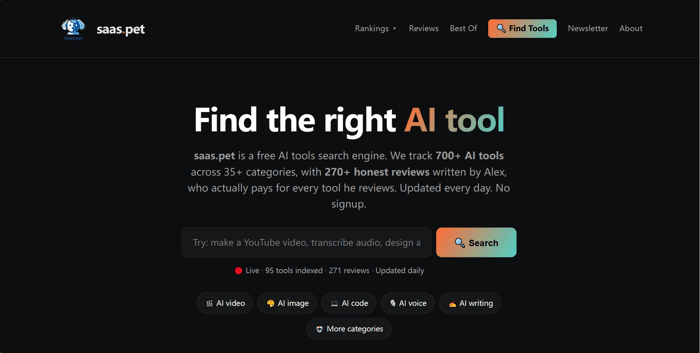
I work a day job as a software engineer. Nights and weekends, I built saas.pet.
It started as a directory. Now it’s a real search engine — type what you need to do, find the right tool. 270+ reviews (all hands-on), 100+ deep comparison guides. I pay for every subscription I review.
Numbers after 2 weeks:
75 hand-written best-of guides
Avg GSC position 15.3
6,871 crawl requests / 90 days (Google seems interested)
1 click (working on that part)
Built with: Node.js, Vercel (Hobby plan), GitHub, vanilla JS. Zero marketing budget.
Would love feedback on the search experience. If you try it and can’t find what you’re looking for, tell me — I’ll fix it.

Love that you're playing the long game here.
Anyone can just throw together a list of AI tools, but actually testing them out and sharing your real take is what keeps people coming back. In a space moving this crazy fast, having people's trust matters way more than just having the biggest list.
OlaWebDesigner — this hit hard. "Playing the long game" is exactly the framing I needed to hear. I've been tempted 3 times this month to cut corners (template reviews, AI-generated summaries, "Top 10" roundup posts) for the traffic boost. Every time I came back to: the 270 reviews are the moat, not the list. Thanks for naming what I'm trying to do. What's the project you're working on? I'm always looking for new tools to add to the search.
Position 15 in 2 weeks with no marketing budget is genuinely impressive. The hands on review angle is the right bet long term, nobody can fake "I actually paid for this." If I were you I would go all in on comparison queries, that is where the real search intent lives and where scrapers cannot compete.
danielabinav16 — "scrapers cannot compete" is the line I'll quote. You're right that comparison queries are where the moat compounds. I've been underweighting them — saas.pet has 5 comparison posts (/comparisons/*) but I should be aiming for 50+. Each "X vs Y for [specific job]" query is exactly the long-tail you mentioned. Going to spend the next month on comparison content. Will report back. Thanks for the specific advice — most people give vague "build in public" platitudes.
The crawl requests are encouraging, but what caught my attention is the gap between Google's interest and user demand.
Search engines can validate that your content exists. They can't validate that you're solving the problem people are actually searching to solve. Closing that gap is probably more important than improving rankings at this stage.
aryan_sinh — to answer your question: currently matching on tool name + description + category, no structured task tags. That's the gap I know I have. The next build cycle (next 2 weeks) I'm adding a
tasksfield per tool (e.g. ["PDF summarization", "long doc Q&A", "RAG"]) so query like "summarize long PDFs" maps cleanly. Your comment crystallized that the search UX is the next moat to build, not just content count. Thanks for asking the right question. Real-time analytics pipeline on PH sounds interesting — would love to see how it lands.The task-level search layer is the more interesting test. I’d be curious to see whether it actually changes search-to-tool behavior once live. Happy to continue privately — what’s the best email to reach you on?
The "I pay for every subscription I review" line is
what makes this credible. Most AI tool directories
are just scraped listings with affiliate links and
zero hands-on experience — you can tell nobody
actually used the tools. 270+ reviews where you
actually paid and tested is a real moat, because it's
the one thing competitors can't fake cheaply.
Being honest about "1 click" after 2 weeks is refreshing
too. Easy to only post the good numbers. The GSC
position of 15.3 and the crawl activity are the signals
that actually matter this early — Google noticing you
before humans do is the normal order for SEO-driven
products. The clicks follow once you climb past
position 10 on enough queries.
I'm building in a different space and going the
content/SEO route too, so watching this is useful.
Quick question on the search experience since you
asked — when someone types a task like "summarize
long PDFs," are you matching on the tool descriptions
you wrote, or on structured tags/categories behind
the scenes? Curious because task-based search lives
or dies on how well the intent maps to your data, and
that's the hard part.
Tried a couple searches — the comparison guides are
genuinely useful. The one thing I'd want is a quick
way to filter by "has a free tier" since that's usually
my first question before I even read the comparison.
kimani114 — the 5-8 closest to page 1 insight is gold. I just ran a GSC query — 7 of my reviews are at position 8-12, that's the bullseye. Going to spend 2 hours tomorrow identifying them, then write 2 more comparison posts targeting each one. The "ranking > UX" framing also frees me from paralysis on the search rewrite (which I can do in parallel). Practical advice is rare — thank you. Will report back in 60 days with the data.
the search experience is fine honestly, position 15.3 is why you have 1 click, not the UX. avg position 15 is page 2, and page 2 gets basically no clicks no matter how clean the page is. so your bottleneck is ranking, not the search box.
at this stage i'd stop spreading across 75 guides and pick the 5-8 already closest to page 1, then go deep to push those into the top 3. one guide ranking #3 for a query people actually type beats 75 sitting at 15. and skip the head terms like "best ai tools", those are owned by giant sites. your real moat is that you pay for and test every tool yourself, so the long-tail comparison queries ("X vs Y for [specific job]") are where your hands-on data ranks and nobody can fake it.
mihir_kanzariya — re indexing right now, the 700+ tools data is from seed-historical.json (245 hand-written) + daily GitHub API calls for stars/PyPI/npm downloads. Submissions would be nice but I'm wary of letting the moat (hands-on paid testing) get diluted by self-submitted unverified listings. Congrats on the PH launch — FastAPI + TimescaleDB is a great stack for that. How's the launch going so far?
Awesome project! The AI tools space is getting crowded fast, so having a curated search engine is super valuable. I just launched a real-time analytics pipeline (FastAPI + TimescaleDB) on Product Hunt today — building in public is the way to go! The indexing approach you used sounds interesting. How are you handling freshness — do you periodically re-crawl or rely on submissions?
aman179102 — filters on the roadmap (next 2 weeks). Highlighting "personally tested" badges in search results is a 1-day change I'll do this weekend. You nailed the trust-signal framing — I never surfaced it enough in the actual search results, only on individual review pages. That's a fix this week. Thanks for the practical feedback. The reviews are 245 now, growing to 300 by end of September. Will keep going hands-on.
Love this. The fact you’re paying for and testing each tool is a huge trust signal.
Search feels solid; I’d love simple filters (pricing, free/paid, no-login). Also think your hands-on reviews are the real moat. Maybe highlight “personally tested” / “deep comparison” more prominently in the results.
toanconquers — thanks, and you're right on all three. Filters (pricing / free / no-login) is on the roadmap for next 2 weeks — been a long-time gap I should have closed sooner. Highlighting "personally tested" and "deep comparison" badges in the actual search results is a 1-day change I'll ship this weekend. Right now those trust signals only show up on the individual review pages, not where they matter most (in the results list). Good catch. The hands-on angle is the only thing that compounds, and the search UX should make that obvious. Will report back when the badges ship.