The Quiet Positioning Trick Small Products Use to Beat Bigger Ones
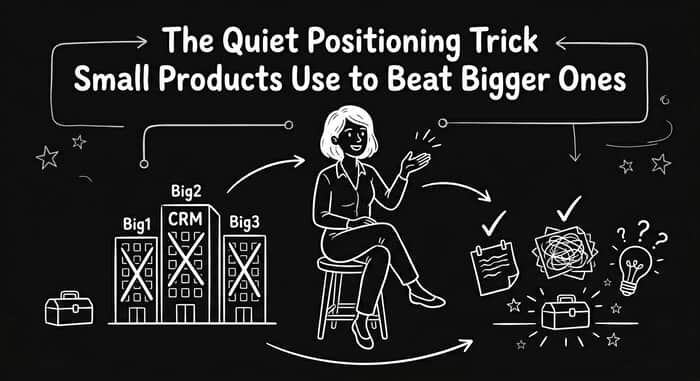
Something I’ve noticed after looking at a lot of indie products.
Small products almost never beat big competitors on features.
Trying to outbuild companies like Salesforce, HubSpot, or Notion is a losing game for a solo founder.
But some small products still win.
Not because they build more.
Because they change the comparison.
Example.
A founder launches a new CRM.
Immediately the product gets compared to:
• Salesforce
• HubSpot
• Pipedrive
That’s a brutal battlefield.
But sometimes the founder reframes the product.
Not:
“CRM.”
Instead:
“A relationship tracker for founders who hate CRMs.”
Now the comparison changes.
The alternatives are no longer Salesforce.
They are:
• messy spreadsheets
• scattered notes
• forgotten follow-ups
• your own memory
Those are much weaker competitors.
That’s the quiet positioning trick.
Most founders think positioning is about writing better messaging.
But the real leverage happens earlier.
It’s choosing a frame where your product isn’t being compared to the strongest players in the market.
Small products rarely win by beating big tools.
They win by changing what they’re compared against.
Curious — have you seen a product do this well?

This framing is underrated.
A lot of products fail not because the product is bad, but because the comparison set is wrong.
If your product gets mentally compared to a category leader, users immediately expect feature parity.
But if the product is framed as solving a very specific workflow, the comparison shifts from “feature completeness” to “does it solve this exact problem better?”
I’ve seen this especially with tools that generate reports or summaries automatically — they don’t compete with full project management suites, they compete with the painful manual process people currently use.
Curious — do you think this kind of positioning has to be intentional from day one, or do products sometimes discover their real category later?
Good point. I think it can happen both ways.
Some founders intentionally choose the comparison set early. That’s usually easier when the product starts from a very specific pain point.
But a lot of products actually discover their real category later, usually through user behavior.
Example pattern I’ve seen:
A founder launches something as a “tool” inside a big category.
But users adopt it for a very specific workflow the founder didn’t expect.
Over time the positioning shifts from:
“another tool in category X”
to
“the easiest way to solve this specific problem.”
Calendly is a classic example.
It technically sits inside scheduling / calendar tools, but it really won by reframing the problem around eliminating back-and-forth meeting emails.
That comparison wasn’t Google Calendar vs Outlook.
It was:
“5 emails to schedule a meeting” vs “send one link.”
Once the comparison changes, the product suddenly feels obvious.
I think a lot of successful indie products stumble into that reframing through early users.
That Calendly example is spot on.
Once the comparison shifts from “another scheduling tool” to “the easiest way to remove back-and-forth,” the product suddenly becomes much easier to understand.
I think that’s often the real signal that a product has found its positioning — not just when users like it, but when they describe it through a specific workflow instead of a broad category.
Curious: in your experience, what usually reveals that shift first — user interviews, usage patterns, or the language people naturally use when recommending the product?
This clicked for me when positioning a payment recovery tool. The obvious frame was 'vs. other dunning software' — too much resistance. The unlock was reframing the competition as 'what are you doing right now?' — which for most founders is 'emailing manually and hoping for the best.' Suddenly you're not competing against established players at all. You're competing against a sticky note.
That’s a strong example of the shift.
A useful test for positioning is asking “what behavior replaces the product if it doesn’t exist?” Not which tool — which behavior.
Most of the time the answer isn’t another SaaS product. It’s something messy and manual: spreadsheets, reminders, sticky notes, half-written emails.
Once the comparison moves there, the product stops being evaluated against feature-heavy platforms and starts being evaluated against friction and forgotten tasks.
And software almost always wins that comparison.
Great breakdown on positioning! Being a 'small' player is actually an advantage for what I'm building right now.
I'm developing Lumen AI (spiritual intelligence) from Congo 🇨🇬. While big AI models are 'generalists', I'm focusing on a very specific niche (theological accuracy for believers) using a custom RAG stack. It's exactly that 'Quiet Positioning' you're talking about—focusing on a specific community rather than fighting the giants.
Thanks for the insights, this confirms I'm on the right track with my niche!
That’s a good instinct.
Niche positioning tends to work best when the product is optimized around one community’s definition of “correct.” In your case that’s theological accuracy, which most general models don’t prioritize.
What usually makes these niche plays durable isn’t just the audience — it’s the evaluation criteria. If believers judge answers based on doctrinal alignment, trusted sources, or specific traditions, then a general AI model isn’t really competing on the same axis.
At that point it stops being “another AI assistant” and becomes a tool built for a specific belief framework, which is a very different comparison.
Exactly! 'A tool built for a specific belief framework' is the perfect way to describe Lumen AI.
You're right about the evaluation criteria. For our community, 'correctness' isn't just a logical output—it's about doctrinal alignment and trusted sources. A general AI might give a 'correct' linguistic answer but a 'wrong' theological one.
By focusing on this specific 'axis' of trust and accuracy through our RAG architecture, we are effectively removing ourselves from the 'AI feature war' and building a dedicated space for believers.
Thanks for the 'Quiet Positioning' framework, it’s a game-changer for our GTM (Go-To-Market) strategy in Africa!
Positioning alone rarely saves a small product.
It only works when it reflects a real operational difference.
What successful small tools usually do is simpler:
they remove friction from one specific workflow.
Not better messaging.
Better workflow design.
Once the workflow becomes simpler, the positioning almost writes itself.
Most founders reverse the order.
They search for a clever positioning angle before fixing the workflow — which is why many products sound differentiated but feel identical once you start using them.
That’s a great point.
If the underlying workflow isn’t meaningfully different, the positioning eventually collapses once people start using the product. You can’t message your way out of that.
In many cases the best positioning is just a clear description of a simpler workflow. When the product genuinely removes friction from one specific task, the differentiation becomes obvious.
You’re right. If the underlying workflow isn’t meaningfully different, positioning eventually turns into a messaging game rather than a real advantage. The products that actually win usually remove friction from a very specific step in the workflow.
Exactly. And the interesting part is that when the workflow actually changes, the positioning usually becomes very boring....but very clear.
It stops sounding like marketing.
It becomes something like: “the fastest way to do X if you currently do it manually.”
Many successful small tools look simple from the outside for that reason. They’re not trying to redefine the whole category — they’re compressing one painful step from 20 minutes to 2 minutes.
When that compression is real, people feel it immediately in the product. And at that point the positioning is just describing what already happens when someone uses it.
That’s a great way to phrase it. The interesting thing is that when the positioning becomes “boring,” it usually means the product is finally aligned with a real workflow instead of trying to invent a category.
That’s a great observation.
When positioning becomes “boring,” it usually means the product stopped trying to sound novel and started aligning with how people already think about the job they’re doing.
At that point you’re no longer educating the market about a new category......you’re simply saying “this is the faster way to do the thing you already do.”
Ironically, that kind of positioning often spreads faster because people can immediately place it inside an existing workflow instead of having to learn a new mental model first.
Hi Sonu, I love this point, I'm also interested in the best ways you actually do that in specific examples, like do you focus on a singular feature you do much better and bring that out the most and basically say this is "what we are"? I also see many overlapping themes here with the "blue ocean strategy", where you basically use marketing and positioning to create an "uncontested" blue ocean, where you try to create a new category with the product that you launch. The idea being that this new category is something important, and it's also something easy to understand, but you're also the only one doing it. So you can contrast yourself to a legacy set, where you are the undisputed leader of a new category.
Great question. In a lot of cases it does start with a specific pain or workflow you solve much better, and then you position the product around that instead of the broader category.
So instead of saying “we’re a better CRM,” you highlight something like “the easiest way to track warm intros” or “a CRM for founders who hate updating CRMs.” The feature becomes the entry point, but the positioning reframes the whole category.
And yes, there’s definitely overlap with Blue Ocean thinking. The difference I often see with indie products is that the “new category” doesn’t have to be huge ...sometimes it’s just a very narrow use case that big tools ignore. That’s often enough to escape the direct comparison.
This resonates directly with how I positioned RecoverKit.
The obvious frame: 'another dunning tool' — instantly compared against Churnbuster, ProfitWell Retain, Stripe's built-in retries. That's a losing fight for a solo product.
The reframe: 'the automated payment recovery email sequence for indie hackers running Stripe subscriptions.' Now I'm not fighting the platforms — I'm the thing platforms don't do. Stripe retries the card, but it doesn't send a human-sounding Day 1 / Day 3 / Day 7 email sequence to the customer explaining why their payment failed and how to fix it.
The comparison set becomes: 'writing those emails yourself' or 'doing nothing.' Both of which most indie hackers are currently doing.
One frame = brutal commodity war. Other frame = obvious solution to a specific, annoying, recurring problem. Same product, completely different conversation.
That’s a perfect example of the comparison shift.
“Dunning tool” puts you straight into a feature war with bigger platforms. But “automated payment recovery emails for indie hackers” changes the mental model completely.
Now the comparison isn’t Churnbuster or Stripe — it’s doing nothing or manually writing those emails every time a payment fails.
I think that’s the key pattern: when the alternative becomes a manual workflow, the product suddenly feels much more obvious.
Nice positioning.
Specificity beats breadth for small products every time. The big player says 'CRM for everyone' and the indie product says 'CRM for solo consultants who hate CRMs' - and the solo consultant buys the indie product because it feels like it was made for them.
The trick is finding a segment that's genuinely underserved, not just slightly different. Generic tools built for teams don't fit solopreneurs - the workflow is different, the scale is different, the feature priorities are completely different.
Building a Solopreneur Notion OS on exactly this positioning principle: it's not a general business template, it's a complete operating system for founders running a one-person business at /bin/bash-5K MRR. The specificity creates instant recognition for the right buyer and filters out everyone else. What's the positioning angle that worked best for your product?
This is the most underrated lever in early-stage positioning.
The frame determines the comparison set, and the comparison set determines whether you win or lose before you even explain what you do.
I see this with outbound tools specifically. If you call something "a lead enrichment tool," you're on a battlefield with Apollo, Clay, ZoomInfo. You lose.
But "a script that does the one thing you actually use Apollo for, without the $150/mo subscription" — now you're competing against the subscription contract and the spreadsheet. Both are much weaker opponents.
The trick is that this repositioning feels wrong at first. It sounds smaller. "You're not a platform, you're just a script?" But smaller scope with tighter fit usually beats broad scope with weak fit at the early stage. The "platform" comes after you have customers, not before.
Positioning that makes the right people immediately say "yes, that's my problem" is worth 10x better copy on a broadly-positioned product.
This is exactly right and it's underused even by founders who intellectually understand it.
The comparison set is the positioning. If you let users (or investors) define the comparison, you'll always be "a smaller version of X." If you define it yourself, you choose weaker alternatives.
The unlock for small products is usually specificity of customer rather than specificity of feature. "A CRM for founders who hate CRMs" still sounds like a CRM. "Built for B2B founders doing 1-5 deals a month who need context on each contact without having to log calls" changes the comparison set entirely — now you're not competing with Salesforce, you're competing with whoever someone was using to track that context before (usually a notes app or nothing).
The other thing worth naming: this framing is also a distribution unlock. "Founders who hate CRMs" is a community you can find and talk to. "People who need a CRM" is not. Tight positioning doesn't just change who you're compared against — it changes where you can show up and what you can say.
The "small and specific beats broad and generic" thesis is correct and persistently underestimated — especially against well-funded competitors.
The mechanism is trust compression: a narrow product makes a bold, verifiable claim that a broad product can't. "The best prompt builder for Claude" is more credible than "the best AI tool."
Going through this exact positioning exercise with flompt — a free visual prompt builder. Instead of "AI productivity tool," the positioning is "prompt blueprint builder that compiles to Claude XML." Narrow, specific, verifiable. github.com/Nyrok/flompt — a ⭐ would mean a lot 🙏
“Trust compression” is a great way to put it. The narrower the claim, the easier it is for users to verify it in their own workflow. “Prompt blueprint builder for Claude XML” is exactly the kind of positioning that shifts the comparison from generic AI tools to a very specific job. That’s where small products usually win.
This is exactly what I have obviously over right now i'm 17 years old from India building compete iq and I told that helps early stage founders understand their competitive landscape and position against bigger competitors the position trick I keep seeing is that small products will not be competing on features but by owning a specific moment or specific customer that bigger payers ignore completely like how we are targeting a list as you found us that crayon and klue completely ignore because they only care about enterprise the riches are in the niches as they say what is the most surprising position move you have you have seen a small product used to be a much bigger competitor ?
Exactly — 'benign neglect' is a much more accurate name for what's actually happening.
The founder knows the payment failed. They get a notification. They think 'I should follow up' and then don't because it's slightly uncomfortable. The customer loses access and eventually just... cancels, or doesn't notice they already cancelled. Neither party made a decision. It just evaporated.
This is why the urgency email on Day 7 ('your account pauses tomorrow') has the highest conversion rate in the sequence — not because it's threatening, but because it makes the cost of inaction visible for the first time. Avoidance only works when there are no consequences in sight.
I'm going to use 'automating the task people know they should do but realistically won't' as positioning language — that's more honest than the recovery rate numbers.
that test is exactly right, and it's clarifying to run it on RecoverKit.
'what behavior replaces it if it doesn't exist?' → the founder awkwardly ignores the failed payment email. they tell themselves Stripe will sort it out. maybe they draft a manual follow-up, never send it. the customer quietly cancels. nothing visible happened — no dramatic churn event, just a credit card that quietly stopped working.
software almost always wins that comparison because it removes the friction of a conversation nobody wants to have.
this framing is more honest than 'we recover 5-10% of MRR' because it names the real substitute: avoidance.
That’s a really honest way to frame it.
A lot of SaaS positioning talks about percentages and metrics, but the real competitor in many cases is exactly what you described: benign neglect.
Nothing breaks. Nothing alerts you. The failed payment just quietly turns into churn because following up feels slightly uncomfortable and easy to postpone.
When software replaces avoidance rather than another tool, the value becomes much clearer. It’s not just “recovering revenue,” it’s making an awkward but important task happen automatically.
And those are often the best automation products — they take care of the small conversations or follow-ups that people know they should do, but realistically won’t.
the beauty app space has this exact dynamic — the obvious comparison is "another skincare tracker" which puts you next to every wellness app on the store. the reframe that actually resonates is comparing against the alternative people are already using: a notes app, a spreadsheet, or just trying to remember when they opened something. those are much easier to beat than a polished competitor with a marketing budget.
the positioning shift isn't just messaging either — it changes what features you build and what you leave out.
This is exactly how we've been thinking about ThreadLine. The obvious frame is "email client with a timeline view" — which puts you next to Gmail, Outlook, and every other inbox. The reframe: not an email client, but a case timeline for professionals who live in email. Law firms, HR teams, consultants — they don't need another inbox. They need to reconstruct what happened across 60 threads without spending 3 hours on it. The comparison shifts from Gmail (impossible to beat) to "the attorney manually reconstructing a contract dispute the morning of a deposition" (easy to beat). Same concept as your CRM example — changing what you're measured against changes everything.
This is a great example of the shift.
What you really changed there isn’t just the message — it’s the unit of value the product is organized around.
Gmail and Outlook are optimized around messages. Your frame is optimized around cases. Once that becomes the organizing principle, the comparison with email clients stops making sense because they’re solving a different operational problem.
A lot of successful vertical tools do something similar. They don’t try to improve the general tool — they restructure the workflow around the artifact that actually matters in that profession (case, deal, ticket, patient, etc.).
When that happens, the positioning becomes almost unavoidable because the product is literally built around a different mental model.
Positioning > features every time. I run 6 niche AI tools and the ones gaining traction are the ones positioned around a specific workflow, not the ones with the most features. When you own a narrow positioning, you become the default for that use case. Bigger tools can't compete because they have to stay general.
I love this because it automatically separates you from any competition and puts you in your own lane. Give us smaller founders a fighting chance!!!
The product I'm building went through exactly this shift.
Originally I positioned it as "a personal communication guide" - which put it in comparison to journaling apps, personality tests, self-help tools. Nobody was looking for another one of those.
The reframe was realizing the real competition isn't another app. It's the status quo: having the same exhausting conversation over and over with every new person in your life, typing a wall of text into someone's intake form and wondering if any of it lands, carrying all that emotional labor silently.
Once I positioned against that - "stop re-explaining yourself" - everything simplified. The value was immediately obvious. And the comparison became: do this hard thing repeatedly for the rest of your life, or do it once and let the document travel with you.
Much easier to win against scattered notes and emotional exhaustion than against Notion.
That’s a really interesting shift.
You moved the comparison from tools to a repeated life problem. Once the alternative becomes “keep re-explaining this forever,” the value becomes much clearer.
And you’re right....competing against emotional friction or manual effort is a much easier battle than competing against a giant tool like Notion.
Nice reframing.
Thanks for naming that so clearly. The shift happened when I stopped asking "who else does this?" and started asking "what does someone do when they're tired of re-explaining themselves?" The answer was that they either give up and mask, or they write a wall of text and hope for the best. Neither is good. That's the competition.
That’s a sharp way to frame it.
What you really uncovered there is the moment of fatigue in the workflow the point where people are already doing something awkward or emotionally expensive just to move forward.
When a product anchors itself around that moment, the comparison naturally shifts from “which tool is better” to “do I keep tolerating this friction or remove it?”
And those are very different buying decisions.
A lot of products get stuck because they define competitors as other software. But in many cases the real competitor is the coping mechanism people built to survive the problem ....masking, long explanations, messy notes, repeated conversations.
Once the product removes that coping mechanism, the value tends to click much faster.
The 'coping mechanism as competitor' reframe also changed how I think about why people hesitate to pay. The coping mechanism is technically 'free' — it costs emotional energy, not money. So until someone has named that cost to themselves, the math doesn't make sense to them. Part of what the product has to do is help them see the thing they've been tolerating as a cost at all.
Exactly. The tricky part is that coping mechanisms feel free because the cost is paid in energy, time, or emotional load instead of money. Until the product helps people recognize that hidden cost, the value proposition doesn’t fully land. Once that cost becomes visible, the decision to switch becomes much more rational.
ran into this exact thing with my product.
first positioning: "AI-powered coaching platform." polite interest, zero signups. coaches thought I was trying to replace them.
repositioned to: "AI back-office for coaches." signups started.
same product. same features. different frame.
the insight was that coaches are experts — they don't want AI to do their job. but they hate the 45 minutes of paperwork after every session. the back-office angle speaks to the real pain without threatening their identity.
small products can be sharper about this than big ones. Salesforce can't say "we handle the boring CRM stuff so you can focus on actually selling." they have to sell the vision. you can just describe the exact thing that hurts.
That’s a great example.
What you changed there is subtle but powerful — you removed the identity threat from the positioning.
“AI coaching platform” sounds like the product is trying to replace the coach.
“AI back-office for coaches” sounds like it’s supporting their work.
Same technology, but the psychological framing is completely different.
I also like your point about big products. They often have to sell a broad vision, while smaller products can win by describing a very specific pain that people already feel every day.
That clarity is often where small products have an advantage.