a16z says "these startups don't exist yet - it's your time to build." I've been building one.
1. The call
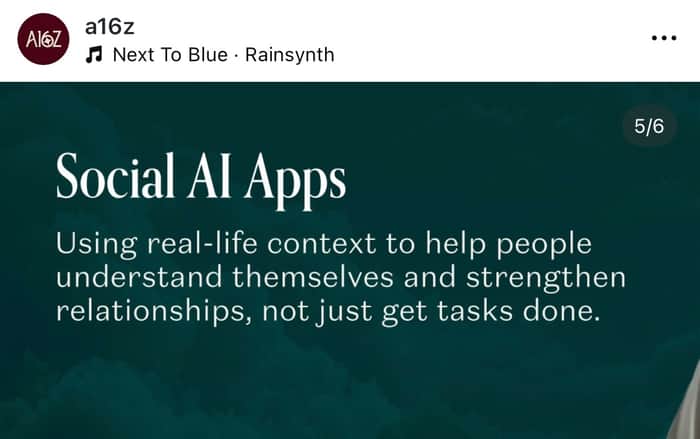
In their 2026 Big Ideas, a16z called out a new category: Social AI Apps.
Their definition: "using real-life context to help people understand themselves and strengthen relationships, not just get tasks done."
Then they said: these startups don't exist yet. It's your time to build.
I'd already been building exactly that for months.
2. Why I started
Every major AI product optimizes for output — coding, writing, automating.
The entire industry built for productivity.
But the biggest pain points in most people's lives aren't about output.
We live in an era where AI is replacing jobs, social media rewards performance
over honesty, and everyone is quietly overwhelmed but nobody says it out loud.
- Scrolling feeds full of people who seem fine
- Wanting to be honest, but everything online is public and permanent
- Feeling something you can't name with no one who truly gets it
The problem isn't that people don't want to connect. It's that every platform
makes connection feel like a performance.
3. The data no one talks about
The US Surgeon General declared loneliness a national epidemic. 57% of Americans are lonely — Gen Z and Millennials are lonelier than any generation before them, despite being the most digitally connected. 61% of young people say loneliness takes a toll on their mental health.
More social apps. More loneliness.
Existing social media gives you an audience. It doesn't give you understanding. WHO now identifies loneliness as one of the defining public health challenges of our time.
4. Who this is for
Re:feel is built for three groups:
-
People who already journal — but feel like they're writing into a void.
They reflect, they process, but the feeling of "does anyone else feel this?" never gets answered. -
People burned out by traditional social media — who want to share something real but won't, because everything is tied to their name, their face,
their reputation. -
Gen Z creators — who already express emotions through art, avatars, and
aesthetics rather than text. For them, an AI character that translates
feelings into artwork isn't a feature. It's the language they already speak.
The moment we're building toward: two strangers realizing they felt the same thing — even if one had a bad day with their boss in New York, and the other had a fight with their parent in Tokyo. Different stories. Identical emotion.
5. What We built
Re:feel — an AI social app where:
- You create your emotional self — a personal AI character
- You journal privately
- Your feelings become AI art, expressed through your character
- You share anonymously with people who felt the same thing
- You connect and message them — privately, across any language
Core insight: emotions are private, but the experience of having them is universal — across every language, every culture, every timezone.
Words can be translated. Emotions can't. Re:feel translates the words, and lets the human feeling do the rest.
6. Why this works — the design philosophy
Most social products solve loneliness by adding more layers of performance:
followers, likes, feeds, metrics. But emotions disappear the moment people
feel like they're being watched.
Re:feel goes the opposite direction.
- Anonymous by default — nothing shared connects back to a real identity
- Emotion-first matching — you see people who felt what you felt,
not people who agree with what you think - Art as expression layer — instead of posting raw text, feelings are
expressed through AI-generated artwork. This shapes the tone naturally:
harder to be hostile, easier to be honest. - Private first, social second — journaling is the input. Connection is what emerges after.
The hardest design challenge here isn't technical. It's keeping the space
authentic as it grows. Our bet is that starting from shared feeling — rather
than shared opinion — creates a fundamentally healthier community baseline.
7. Why now
Journaling has tens of millions of users globally, and the global mental health app market is projected to exceed $20B by 2030. But none of them have cracked the social layer — the moment when your private emotion finds its people.
Journaling apps have the privacy. Social apps have the connection. Nobody has built the bridge — until now. AI finally makes it possible to go from private feeling to anonymous human connection, across any language, at scale.
That's the white space Re:feel is building in.
We just opened our waitlist. Launch is coming soon.
👉 https://refeeljournal.com/
And for the builders here:
Would you use something like this? What's missing?

social apps are the hardest category to grow with paid - the value is the feeling of being genuinely understood by other people, and you can't really show that in a 15-second meta creative. the apps that break through in this space usually do it via organic tiktok content that makes people feel the emotion before they even install. curious what your thinking is on early growth - with something like re:feel you probably need real density before paid makes sense anyway, right?
That's a great point. Social apps are definitely hard to grow purely with paid because the real value only shows up once people actually experience the interaction.
Early on we're focusing more on seeding the first community. We'll likely start with micro-influencers and creators who already talk about journaling, mental health, or Gen Z self-expression. We're also experimenting with short visual content on platforms like TikTok, since the emotional side of the product is easier to communicate visually than through traditional ads.
And you're right that density matters a lot here. The experience really works once enough people are sharing and matching around similar emotions. From there, we're hoping the sharing mechanics in the product (like Instagram story sharing) help it spread more organically as the community grows.
The gap between private journaling and social connection is real. How are you solving the cold start problem though? Need enough users feeling the same thing at the same time for it to work
That's a great question. Early on we're focusing on people who already journal or think about emotional reflection a lot, things like journalers, mental health communities, and Gen Z creators.
We'll start with some micro-influencer marketing to get the first users in. Since the product really depends on people being there at the same time, the early phase is mostly about getting enough activity in the system.
From there, the sharing features in the product can help things spread more organically once the initial community forms.
The core insight here — emotions are private but the experience of having them is universal — is genuinely compelling, and the anonymous cross-language connection mechanic could sidestep the "performance vs. honesty" trap that kills most social apps. What you're really building is a matching layer on top of private journaling, which is smart because it preserves the safety of the private entry point while still creating the social reinforcement loop that keeps people coming back. The hardest design challenge you'll face isn't technical — it's preventing the anonymous social layer from degrading over time the way all anonymous communities eventually do (Whisper, Secret, etc.) once the initial earnest users are outnumbered. The AI art translation of feelings is an interesting differentiator there because it adds a layer of interpretation that may reduce the bluntness that tends to invite pile-ons. Curious what your theory is for maintaining emotional safety and authenticity at scale — do you see moderation, algorithmic matching by emotional state, or the AI character layer itself as the primary defense against that drift?
That's a great question. Our main thinking is that emotional matching does most of the work. Posts are tagged by emotion and organized into emotion-based feeds, so people mostly encounter others who are feeling something similar rather than clashing viewpoints.
The AI character and artwork layer also helps shape the tone of expression. Instead of posting raw text, people express what they felt through their character and the artwork it generates. That means the feeling is expressed through a visual interpretation rather than direct statements, which can make interactions feel less confrontational than typical anonymous text posts.
The idea is that starting from shared feelings rather than arguments can naturally create a healthier tone in the community. But honestly, how that holds up at scale is something we'll only really learn once real communities start forming.
This is the interesting moment in tech cycles where the tooling is suddenly powerful enough, but the actual products haven’t been built yet.
Feels like the opportunity is less about inventing new tech and more about applying AI to really specific workflows.
I agree. The models already exist. The interesting shift now seems to be less about inventing new AI and more about identifying the right human problems and designing products around them.
Yeah exactly. It feels similar to what happened after smartphones became powerful enough. The hardware existed first, and then a wave of products appeared once people figured out the right workflows to build around.
AI feels like it's entering that same phase now.
The retention problem you're describing is real, and the anonymity layer is probably your best bet for solving it - but it creates a different challenge. Anonymous communities tend to either get very authentic very fast, or they attract behavior that poisons the well and drives genuine users away.
The products that have threaded that needle (Whisper briefly, parts of early Reddit, some Discord servers) did it by being very deliberate about what emotions/topics they amplified in feeds and what they quietly suppressed. The algorithm was doing a lot of trust work that nobody talked about.
The question I'd be sitting with: once you have real user data, what does the 'day 3 drop-off' look like for the people who do stay vs. the ones who leave? The shape of that cohort usually tells you whether the social layer is carrying the retention or whether it's the journaling itself. If it's the journaling, you're building a journaling app with a social feature. If it's the social matching, you've got something genuinely different.
That's a really thoughtful point. Anonymous spaces can unlock honesty very quickly, but they can also go toxic if the environment isn't shaped carefully. A lot of that comes down to product design and what the system ends up amplifying.
Right now the structure is fairly simple. Posts are tagged by emotion and organized into emotion feeds, so people mostly encounter others sharing similar feelings rather than debating opinions. As builders, that means being careful about what the feed highlights. The goal isn't to push conflict or outrage, but to surface moments where people genuinely recognize themselves in someone else's experience.
The retention question you raised is actually the core thesis behind what we're building. Our belief is that people don't come back just to write again. They come back because they're curious whether someone else felt what they felt. Journaling is just the input. The real product moment is the connection that comes after.
The loneliness epidemic isn't solved by another social app it's solved by removing the performance layer. You built the removal: anonymous, emotional, across language. That's not a feature set. That's a design philosophy that most founders wouldn't touch because it can't be optimized.<|end▁of▁thinking|>57% of Americans are lonely. Social apps grew 1000% in that same window. The correlation is uncomfortable but worth sitting with.
That’s a really thoughtful way to put it. A lot of social products optimize by adding more layers of performance, like followers, likes, feeds, and metrics. But emotions tend to disappear the moment people feel like they’re being watched.
What we’re exploring is the opposite direction: removing that performance layer and seeing what kind of connection emerges when people aren’t posting for anyone they know, but instead connecting around the same emotion, even across language and culture.
That's exactly right and it's the harder path. Performance scales. Connection doesn't. You're optimizing for something that can't be A/B tested, which means you have to trust that the feeling itself is the metric. Most founders won't do that.
The harder problem might not be finding people who share your emotions, but building trust fast enough that someone actually wants to be vulnerable with strangers... journaling's appeal is often that it stays private. What's your insight into why existing social networks failed at this, versus being a journaling-first product that adds social later?
The "e-commerce AI tooling" gap is real and massively underbuilt.
Most Shopify operators still write product descriptions manually, copy-paste customer service replies, and build email sequences from scratch — every week. The tools that exist are either too expensive ($200+/mo SaaS) or too generic.
Built a Claude workflow playbook specifically for this: 10 production-ready workflows (product descriptions, CS, emails, competitor analysis, store audit) in an interactive HTML file. $9 one-time.
The demand signal was obvious — threads on r/shopify asking "does anyone use AI for product descriptions?" with 30+ replies. Built exactly that. DM me for the link.
The tension you've identified is real: every major social platform has solved the distribution problem and made the vulnerability problem worse simultaneously. The insight that matching on shared feeling rather than shared opinion is a fundamentally different social primitive is worth sitting with — opinion-matching tends to produce echo chambers, whereas emotion-matching could produce something closer to genuine empathy across otherwise incompatible worldviews.
The hardest design challenge you'll face probably isn't technical, as you noted — it's what happens when the community scales past Dunbar's number and authentic engagement starts to feel performative again. Have you looked at how the moderation and anti-gaming layer would work once people realize emotional matching can be gamed (e.g., tagging posts with emotions strategically to reach certain audiences)? That's the exact point where apps like this have historically fractured between their original vision and what scale demands.
Most connection apps solve for discovery. You're solving for resonance after the fact — someone already had the feeling, and now they find out they weren't alone. That's a fundamentally different UX problem.
What I'm curious about: how do you handle the case where someone's journal entry is dark and the match makes it worse instead of better? That's not a rhetorical question — it seems like the hardest design problem in the whole thing.
That's a really important question. One distinction we make is between private journaling and the shared space. People's private entries are completely theirs. We don't interfere with what someone writes in their own journal.
The shared layer is different. If someone chooses to post to the emotional feed, we do apply safety checks and may prevent extremely harmful content from being shared.
The goal is that journaling remains a private space for processing difficult feelings, while the shared layer is shaped more carefully so emotional matching creates recognition rather than amplifying harm.
The a16z thesis is interesting but the framing that these are unclaimed opportunities rather than hard problems is worth pushing back on. Most of them are hard because of distribution and trust, not engineering. AI tutors are technically feasible, have been for years. The gap is always who do you trust to teach your kid and how do you get the first 1000 families to try it. I am in the middle of this exact challenge running an AI-operated marketing business - the product side is solved faster than ever, the human trust and distribution side moves at human speed regardless of how capable the AI is.
That's a great point. I think you're right that in many of these categories the hardest problems aren't technical anymore, they're distribution and trust.
AI capability is moving incredibly fast, but adoption still moves at human speed. That's actually a big part of the challenge in what we're building too. Getting the first real communities to form and trust the product is much harder than building the technology itself.
The white space framing really landed for me. I had a similar moment in a completely different category — email. Every AI email tool was racing to auto-send on your behalf, but when you actually talk to people, nobody trusts AI enough to let it fire off emails unsupervised. The gap wasn't "faster sending" — it was trust.
So I built a Mac app called Drafted that drafts replies in your voice but never sends anything. You always review first. Different space from Re:feel, but the same core principle — AI should augment human judgment, not bypass it.
Your insight about the bridge between private journaling and social connection is sharp. Journaling apps have the privacy, social apps have the connection, nobody has both. How are you thinking about monetization? The mental health app space has been brutal for most players outside of Calm and Headspace.
I like that framing around trust. “AI should augment judgment, not bypass it” resonates a lot. On monetization, we're thinking about a simple free + subscription model. Free users can journal and use the core social features, since the network really needs to stay open to form. Pro is more about deeper features around reflection, including things like monthly insights to help people understand their emotional patterns over time.
It's still early though. Right now the main focus is making sure the core experience actually creates real value for people.
It's time to build! super excited about the time we live in - let's take a breath in and realise all the incredible opportunities
Absolutely. It really does feel like one of those moments where a lot of things are suddenly possible.
This really resonates. Social AI apps feel like one of those ideas that sound obvious in hindsight, but are incredibly hard to execute well in real life. I love how you connected the a16z “Big Ideas 2026” vision for AI that understands real‑life context with what you’re actually building day‑to‑day as a founder, instead of just treating it as hype or theory.
Glad it resonates. I’m really glad the connection between the a16z idea and what we’re trying to build came through. Still a lot to figure out, but it's been a really interesting problem to work on.
Bridging the gap between a private journal and anonymous social connection is a brilliant way to tackle the loneliness epidemic.
Glad to hear that. Bridging that gap between private reflection and anonymous connection is exactly what we're exploring.
This resonates deeply— I've been building something in a completely different space but had the same experience of working on an idea for months and then seeing it validated by someone with a megaphone. The white space insight is everything. Good luck with the launch, the bridge metaphor is really strong.
Appreciate that. Good luck with what you're building too!
This is so exciting to read! I am 17 years old from Kerala India and I am literally building one of those missing startups right now while studying for my board exams. The gap I identified is that early stage founders have zero affordable tools for competitive intelligence — enterprise solutions cost $3000 per month and nothing exists for pre revenue founders. That gap is exactly what CompeteIQ is solving. The a16z thesis about missing startups is so powerful because the biggest opportunities are always in the spaces everyone else has overlooked. What missing startup are you building and what gap did you identify?
Love the energy. Building something while studying for exams is impressive. The gap we're exploring is emotional connection. Journaling is private and social media is performative, but there isn't really a bridge between the two yet.
There are many AI social app, or AI app, don't you think it could be a bubble ?
There’s definitely a lot of AI hype right now. I think the real question isn’t whether something uses AI, but whether it solves a human problem people actually care about. In our case we’re exploring loneliness and emotional connection. AI is just the tool that helps make that interaction possible.
Building social apps is the master class i feel like. Very hard to do and scale. But if it works it can be extremely powerful. Good luck!
Definitely. Social products are hard to get right, but that’s also what makes them interesting to build. Appreciate the encouragement!
Hey, saw your Re:feel post on IH. Really resonated with me. I'm building Noren, which is in a similar space but for writing voice. You're preserving emotional identity, I'm preserving writing identity. Both pushing back on the idea that AI should flatten people into one output. Would love to connect. Always good to know other founders building in this space.
Appreciate the message, I really like the framing. I took a look at Noren and the idea resonates. A lot of AI generated writing is technically good, but it often turns expression into something interchangeable. The ideas are still there, but the person behind them kind of disappears. That’s what makes the direction interesting to me. Not just improving the output, but keeping the sense that a real human mind is still behind the words. Would definitely be happy to connect. Always good to meet other founders exploring similar questions from different angle.
the a16z alignment is a nice signal but i'd be cautious about using VC thesis papers as primary validation. i built my first product because it fit a trend everyone was talking about — the problem was real but the people who discussed it online weren't the ones who would actually pay for a solution. the gap between "people want this" and "people will use this consistently" is where most emotional/social products die.
the social layer could actually be what solves the retention problem most journaling apps have — but that's the part i'd validate first, not last. if anonymous connection creates a reason to come back beyond just writing, you've found something real. if the journaling alone isn't sticky enough to bring people back after day 3, the social features need to carry that weight from the start.
curious whether you've tested any of the social matching with real users yet or if the waitlist is based on the concept alone.
This is exactly the question we’re trying to answer, and honestly the most important one we’re thinking about too. We’ve done some early testing with people we know, but not with strangers yet, so the social matching dynamic hasn’t really been validated in the wild. That’s the honest answer.
Your framing is also how we think about the retention problem. Journaling alone tends to drop off around day 3, and most apps patch that with streaks or reminders. Our thesis is that anonymous social connection creates a fundamentally different reason to come back. Not habit, but curiosity. Did anyone feel what I felt today? That’s the pull mechanic we’re exploring. That’s also why we built direct messaging and a community layer, so the connection can go deeper than just seeing someone felt the same thing. Whether that holds with real strangers is exactly what we’re hoping to learn after launch.
How ethical is this
That’s a really important question. A big part of the design is making sure people stay in control of what they share. Journaling stays private by default, and sharing is always optional and anonymous. The goal isn’t to manipulate emotions, but to create a space where people can express them honestly and connect with others who felt something similar.
Always cool seeing people take the leap and actually build instead of just talking about ideas. What ended up being the biggest challenge after launching?
Appreciate that. We’re actually still pre-launch. We just opened the waitlist and are planning to launch later this month. So far the biggest challenge has been designing something that encourages honest emotional expression without turning into another performative social feed.
Honestly the hardest part seems to be getting the first real usage loops going. Building something interesting is one thing, but figuring out how people actually incorporate it into their daily behavior is another. Especially with social products, they only become valuable once enough people are using them consistently.
Definitely a novel take on social media. I'm probably not your target audience since I'm not a "journaler" or a social media user. Who is your ideal user?
All the best!
Great question! We’re mainly building this for three groups: people who already journal but wish it felt less lonely, people burned out by traditional social media, and Gen Z users who prefer expressing emotions through art or avatars rather than text.
The moment we’re trying to create is when two strangers realize they felt the same thing, even if they’re on opposite sides of the world. A bad day with a boss in New York and a fight with a parent in Tokyo are completely different stories, but the underlying emotion can be identical. That kind of shared emotional recognition across language, culture, and timezone is what we’re trying to build around.
Sounds well thought out. I'll definitely be following your journey. Might make a journaler of me yet :)
Haha we'll see. Appreciate you following along :)
The idea is compelling. The real challenge might be turning private emotions into meaningful connections rather than just another feed.
Exactly. That's the core design challenge. That's why we don't just throw emotions into a feed. Connection happens through shared feeling, not shared identity. You see someone felt the same thing you did, and that's the entry point. No noise, no performance, just resonance. Whether that translates to meaningful connection at scale, that's the real test. Will find out soon.
This is an interesting take. Most AI products right now really do focus on productivity and output, but a lot of people’s real problems are emotional or social rather than task-based. The idea of using AI around real life context and emotions feels like a direction we’ll probably see more of. If someone actually manages to make that social layer work (without turning into another noisy social feed), that could be pretty powerful.
Curious how you think about moderation and privacy in a space where people might share really personal emotions. That seems like the hardest part to get right. Also wondering what the early user behavior looks like so far. Are people mostly journaling privately, or actually interacting with others around shared emotions? Interesting build either way.
On moderation and privacy:
Journaling is fully private by default. Nothing leaves their personal space unless the user explicitly chooses to share. When they do, it's always anonymous. Nothing that connects back to the real person.
We have a Privacy Policy that explicitly covers data handling, GDPR compliance, and clear disclosure of how AI processes journal entries. Users own their data and can delete everything at any time. The hardest moderation challenge is sensitive content like self-harm, crisis situations. We handle this with content guidelines and AI-assisted flagging.
On early user behavior:
We're still pre-launch, waitlist only, launching very soon. So no behavioral data yet. But my prediction is that the feed will actually be pretty active as anonymity removes the fear of judgment, which is exactly what holds people back on every other social platform. When no one knows who you are, honesty comes naturally.
The honest worry is on the business side. It's a community product, which means free users need enough value to stick around and build the network but Pro needs to feel worth paying for. We're keeping all social features free to drive network effects, while Pro gets deeper features.
Will report back once we launch. These are exactly the things we'll be watching closely. 👍
Really interesting framing with the a16z "Social AI Apps" category. I'm building in a very adjacent space — an AI-powered personal growth and accountability app (growthcoach4u.com) — and I think you're onto something important about AI needing to go beyond productivity.
The insight that "the biggest pain points in most people's lives aren't about output" is spot on. I see this every day with my users. People don't fail at their goals because they lack a better to-do list. They fail because nothing holds them accountable when motivation fades, and nobody checks in to ask "did you actually do what you said you'd do?"
The bridge between journaling (private) and social (public) is a really compelling white space. One thing I'd watch for: the moment you add a social layer to emotional expression, you risk people performing emotions instead of processing them. That tension between authenticity and social incentives is probably your biggest design challenge — and potentially your biggest moat if you solve it well.
Would love to follow your journey. Fellow AI-for-personal-growth builder here, rooting for you.
Thanks for the thoughtful comment. I think you're right that the tension between authenticity and performance is probably the hardest design problem here. Our hope is that starting from private reflection and matching people through shared emotions helps keep things closer to processing than performing, but it's definitely something we'll have to watch carefully as the product grows.
Also great to see other builders working on AI for personal growth. Rooting for what you're building too.
Really appreciate that — and right back at you. The "starting from private reflection" approach is smart. I think that's what makes Re:feel different from the social-first apps that burned everyone out.
We're tackling a similar trust problem from a different angle: getting people to actually be honest with themselves about their goals and progress. Turns out the hardest person to be authentic with isn't a stranger on the internet — it's yourself.
Would be great to stay connected and compare notes as we both grow. The AI-for-personal-growth space is going to be huge, and I think there's room for multiple approaches that genuinely help people.