Our clients have raised over $ 2.5 M in funding. Here’s what we actually do

My name is Vadym, and I'm the founder of Sollas, a design agency focused on product design for SaaS/AI companies. We care about metrics and results.
Our clients successfully raise funding because the design we've done works - it attracts and retains users, making the interaction between user and product seamless.
Design is the bridge between user and product
Not all designers and founders get this, so I've outlined 7 principles of our approach that actually delivers results. Took me 7 years to figure this out (started my design career 7 years ago).
Our service brings insane ROI to clients who order design from us. 80% of clients come back to work with us again. I'm happy to be building this kind of service business!
1. We don't "just design screens."
We work as a product + growth design partner.
For us, design is a tool for getting users and convincing investors, not just making things look pretty. Honestly, I love creating beautiful visual concepts and it brings me joy, but what brings me even more satisfaction is meaningful design that generates $$$ for clients.
We always set goals for the design we're creating - it points us in the right direction. Toward the client's success and their product's success.
2. We design for fundraising, not Dribbble
Our solutions are built for:
- user acquisition and retention
- traction storytelling
- clear product logic
- metrics, metrics, metrics
We do everything we can to help clients attract users and investors down the road. Having the right focus is already half the battle.
3. UX
We design UX to attract, activate, and retain users.
Every flow is built to:
- reduce friction in the first interaction
- get users to their first "aha moment" faster
- create clear feedback loops that keep them coming back
Good UX lowers CAC, increases activation, and compounds retention - all the stuff investors want to see.
Onboarding is like a first date - you don't get a second chance
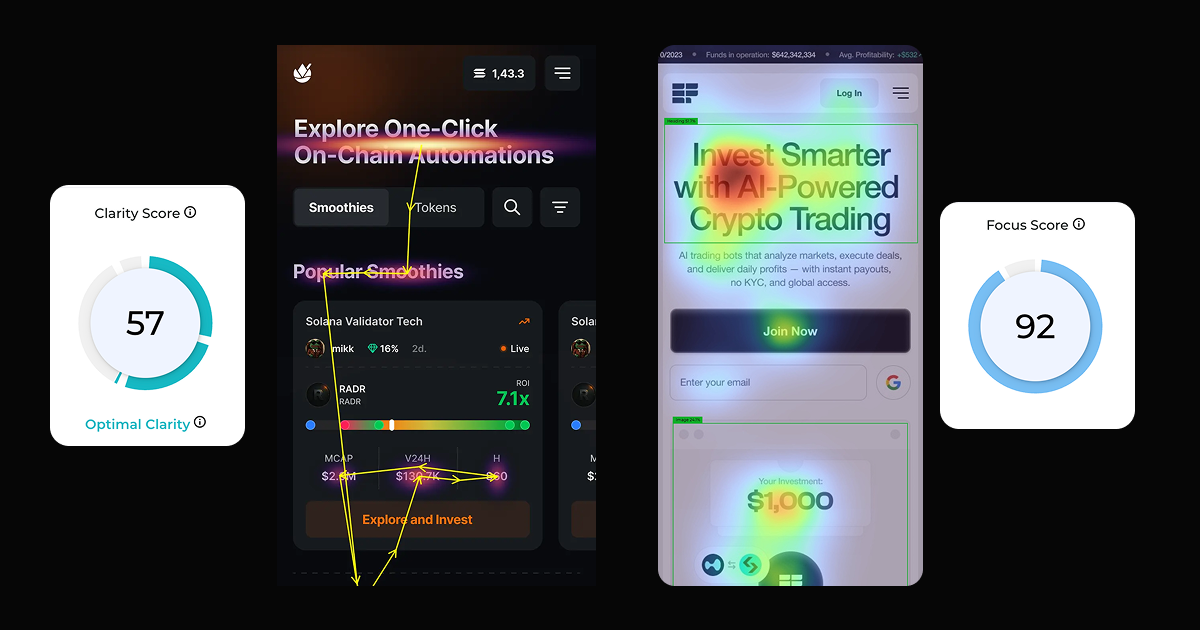
4. Validation before launch
Before we hand off design to development, we test it. This gives us proof that our design decisions can actually work. We save our clients money because mistakes get caught early, at the design stage, and we don't waste developer time. Clients also get to see evidence through:
- A/B testing
- user testing in Figma
- surveys
- hypothesis validation
5. Simple gamification that drives retention
Gamification is my favorite thing. It's not for everyone (at least not right now), but where it fits, it works like magic.
Industry reports (UX Matters) show that adding gamification to digital products can boost engagement by up to ~48% and customer retention by up to ~22% (through loyalty mechanics and gamified flows) - https://www.uxmatters.com/mt/archives/2024/09/gamification-techniques-for-increasing-customer-engagement-and-loyalty.php
We don't make badges just to have badges - we build stuff that actually lifts DAU/retention, and you can see it in the numbers.
- Customization
- Leaderboards
- Rewards
- Levels
- Challenges
Everyone's still a kid inside
6. We speak investor language
We think in terms of:
- CAC / LTV
- funnels
- conversion
You can feel it in the product. We also help clients with their pitch decks.
7. Outcome > aesthetics
The priority is growth, clarity, trust. And the good news? This combines perfectly with good UI. Good UI makes things feel premium, and users trust products that look professional more. I'm not talking about crazy concepts here. Good visual design is simple - it's all about the details.
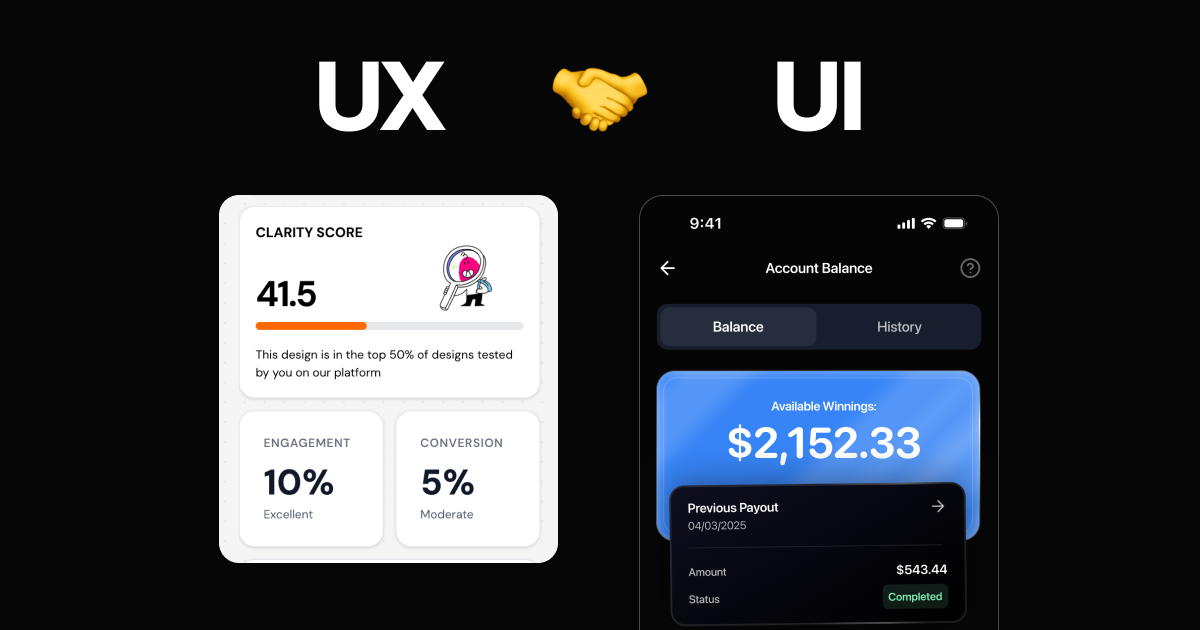
I've been studying this for 7 years, and it's what drives me - conversion and aesthetics. They work together, right now.
If you're building something and planning to raise - the right design helps you tell the right story, fast.
If you need help building an MVP or want to improve your existing product, hit me up. Book a call here
Thanks for reading. Wishing you success with your business.


Great breakdown. Love how you frame design as a growth lever, not just aesthetics
Thank you !
I fully agree with the principles you are outlining here.
I see point 7 as a consequence of good design processes. Strong outcomes and solid aesthetics tend to emerge together.
Wishing you and your studio continued success!
Hey Sergio! Loved your framing treating outcomes and aesthetics as natural byproducts of a disciplined design process is exactly right. It's the same principle that makes agile work when done properly
Thank you!
The "validation before launch" mindset is spot on. It's surprising how many teams still skip this and hope investors will ignore the gaps laterу
Agree, this is a time saver, and confidence
Curious how early most of these startups brought design into the process. Was it pre-MVP or after initial traction?
All of those projects were pre-MVP
Hey Vadim! Your breakdown of design as a fundraising tool is spot on — especially point 4 (validation before launch). That mindset of catching mistakes early maps perfectly to agile sprint thinking.
The paradox here is real though: those design scoring systems (Clarity, Focus) typically measure conformity to SaaS templates, not whether something actually converts.
Early Java UI was considered ugly by every design metric of the time, but it imposed itself anyway because it solved a real constraint problem.
An innovative, efficient design could score equally bad.
Your point about validation before launch is solid, but the metrics that prove it works are never the ones in the circular gauges.
Nice
Love how you combine design with business growth! It’s clear that you focus on what really drives results for your clients.
this is my passion and goal
Thank you!
Curious from your experience —
what’s the most common hidden bottleneck founders discover after working with you?
i just only want to know about the seo can i earn money from seo as local business
This perspective is refreshing as it turns over the common conversation about design. ~
Most teams discuss UX in terms of beauty or best practices. By linking it to capital formation and business performance, you’re referring to what really matters to founders and investors.
There are a few noteworthy aspects.
Creating for capital is different from creating for show. When assessing products at the early stage, one isn’t evaluating the polish but the clarity of traction, narrative, and risk reduction. User experience that brings those signals forward is more important than aesthetics.
The efforts of making sure the product works well before launching it is doing the heavy lifting here. By the time something is designed, the riskiest assumptions should already be dead. Changing the idea that UX is the finishing layer, and thinking of it as an experiment layer instead is a big mindset shift.
When uttered in investor language (CAC, LTV, conversion paths), it makes us understand why it converts. Investors don’t pay for mere interfaces, but for the systems that produce outputs.
Many people think that UX is subjective but that is wrong. At this point in time, it’s a brutally objective scene.
Does it lessen the risks for users and funders?
All seven points are connected through the principle of restraint. You are eliminating uncertainly not creating complication. Usually companies get funded by substance not visual flair.
The kind of post that’s valuable because it illustrates how design decisions compound into business leverage rather than just why they “look good.”