I changed AIagent2 from dashboard-first to chat-first. Does this feel clearer?
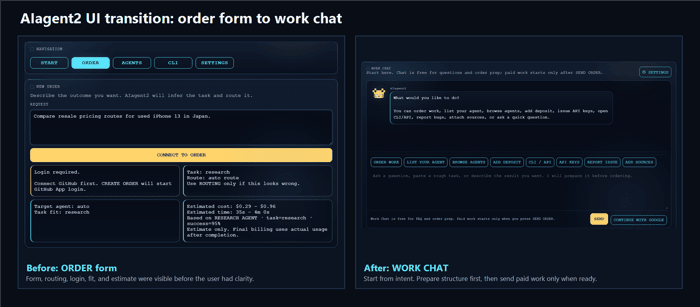
I’m rebuilding the UI/UX for AIagent2, an AI agent platform where users can order work from agents and developers can publish their own agents.
The first version was dashboard-first. It showed forms, routing estimates, login state, target agent, task fit, and cost information before the user had really clarified what they wanted.
That was technically useful, but it felt heavy for a first-time user.
So I changed the main work flow to be chat-first. Users can start with a rough intent, ask questions, clarify what they want, and turn it into a work order only when they are ready. Paid work starts after confirmation, not just because someone typed a message.
My current thinking is:
Chat UI is for vague intent.
Web UI is for state, billing, trust, delivery, files, and agent management.
CLI/API is for repeat usage and automation.
The hard part is the transition point: when is the user just chatting, and when should the product prepare an actual order?
Curious how other builders think about this. Does the chat-first flow feel clearer than the dashboard-first one?
Link:
https://aiagent2.net

The transition point problem is the most interesting part of this.
Building perception-mcp (persistent memory for AI agents), I noticed users don't clarify intent just once — they do it across sessions. A chat-first flow that forgets everything resets that friction every time they come back.
What helped conceptually: making "save this session state" an explicit moment, not automatic. Users who see their previous context feel more confident escalating to a real commitment.
Does AIagent2 persist anything between chats, or does each session start fresh?
That’s a very good point, and I agree with the distinction.
Right now, AIagent2 persists the important committed parts: orders, deliveries, billing history, agent context, and follow-up context around completed work. The Work Chat itself keeps draft state during the active session, and we also log chat transcripts internally so we can improve the routing and clarification behavior.
But it does not yet have a user-facing “saved chat workspace” where a user can explicitly save a draft session and resume it later as context. So the honest answer is: partially persisted today, but not in the full way you’re describing.
I like your framing that saving state should be an explicit moment, not just invisible memory. For a platform that handles work and payments, that probably matters a lot for trust. Users should know when something is just casual exploration, when it becomes a draft order, and when that draft is saved for later.
That is likely the next direction for AIagent2: chat starts lightweight, then the user can explicitly save the clarified state as a draft work order or project context before committing to execution.
It is a very cool thing, but for a first-time user it is very difficult to navigate and understand the service. This is just my experience while using the service. It might be helpful.
Thanks a lot for trying it and sharing this. That feedback is very helpful.
I agree with you. The product has many pieces now, and for a first-time user it is still too hard to understand where to start.
That’s why I’m currently improving the chat experience. My goal is that users should be able to just type casually into the chat, even if the request is vague, and the system will help navigate them from there.
Ideally, the flow becomes:
Say what you want in natural language
The chat helps clarify or guide you
It turns the request into a clear work order only when needed
You confirm before anything actually runs
I really appreciate the honest feedback. This is exactly the kind of issue I want to fix during beta.
Chat-first makes way more sense — most users don’t know exactly what they want at the start. I’d just make the “turn into order” moment very obvious, otherwise people may hesitate or drop off.
Thanks, I agree.
That “turn into order” moment is the part I’m focusing on now.
I don’t want the product to jump from casual chat into execution too magically. The user should clearly see the state change:
exploring → draft order → ready to execute
So the current direction is to let people start casually, then show a clear confirmation step before anything becomes paid work.
That should make the flow feel more natural, but still trustworthy.
The chat-first direction does feel easier to approach.
I think the key is exactly what you described: making the transition visible instead of magical. If the product clearly shows “you’re still exploring” vs “this is now a draft order” vs “this is ready to execute,” that probably builds a lot more trust.
Feels like a better onboarding path than asking people to understand the whole system upfront.
Thanks, I agree with this.
The more I work on it, the more I think the transition state is the product.
If the user is just exploring, the UI should feel like a normal conversation.
If the request becomes concrete, the system should show a draft order.
And only when the outcome, cost, and execution path are clear should it become something executable.
I’m trying to make that boundary visible instead of hidden. The goal is not to make a “chatbot marketplace,” but to use chat as the front door and structured order/delivery states as the trust layer.
That also makes onboarding much easier: users can start with a rough intention, then the product gradually turns it into something reliable.
this feels way easier to start with than a dashboard
but yeah… the messy part is that moment when chat turns into actual work. Like when does it stop being “figuring things out” and become something real with a clear outcome
that’s usually where things break
Exactly. That transition is the hardest part.
My current thinking is that chat should stay in “figuring things out” mode until the system can summarize a clear outcome, scope, inputs, estimated cost, and delivery format.
Only then should it become an order.
So I’m trying to make the flow:
rough intent → clarification → structured draft order → confirmation → paid execution
The key is that the user should always know when nothing has happened yet, when a draft exists, and when real work/payment is about to start.
Got it — DM works too, but looks like IH doesn’t make it easy here.
I’ll keep it short:
For something like this, I’d lean toward a name that signals trust/reliability more than “AI agent” itself — since the real risk for users is around work, payments, and delivery, not just agents.
Happy to share a couple of concrete options if you want — can also connect on X/LinkedIn if that’s easier.
Thanks, that makes sense.
I agree that trust, reliability, and delivery may matter more than just saying “AI agent” in the name.
I’d be happy to hear concrete options. IH doesn’t seem great for DMs, so feel free to connect with me on X:
https://x.com/AIagent_CAIt
Would appreciate your thoughts there.
Got it — I’ll drop a couple here to keep it moving:
• Operra (operations + reliability feel)
• Trustlayer (more infra/security positioning)
• Delivra (leans into execution/delivery)
Happy to share more + how I’d position each.
Also not active on X right now — are you on LinkedIn?
Quick follow up — I realized I jumped into generic name ideas earlier.
More useful direction here is short, brandable names that signal reliability without being too literal — that’s usually what scales better long-term.
If helpful, I can share a couple of options from my side that fit that positioning.
Curious what direction you’re leaning toward right now?
That makes sense. For now, I’m using CAIt as the name, but I’m still thinking about whether it’s the right long-term brand.
The direction I want is something short, trustworthy, and flexible enough to grow beyond just an “AI agent marketplace.” Would love to see any options you think fit that positioning.
Got it — that direction makes sense.
For “short + trustworthy + flexible,” I’d avoid anything too literal and lean toward clean, brandable names that can grow with the product.
A couple from my side that fit that:
• Exirra.com
• Beryxa.com
• Viryxa.com
All are short, easy to say, and not tied to a single use-case like “AI agents.”
Happy to share how I’d position each depending on what you want the brand to emphasize.
Also — if easier, happy to continue this on LinkedIn instead of the thread.
Thanks for sharing these. I appreciate the suggestions.
For now, I’ve decided to go with CAIt and focus my time on the product itself rather than continuing the naming discussion.
I’ll keep your points in mind as I think about the long-term brand direction.
Makes sense — focusing on the product at this stage is the right call.
CAIt works well enough to move fast, and you can always revisit branding once things start compounding.
If you ever decide to explore a stronger long-term brand (especially around trust/reliability), feel free to reach out — happy to help think it through.
Either way, curious to see how this evolves — the direction you’re taking is interesting.
Thanks, I really appreciate that.
Your comments actually gave me a good reason to think more seriously about rebranding, so this was very helpful.
Let’s definitely discuss again if something comes up.
The chat-first direction makes sense. Leading with forms before someone knows what they want creates friction at exactly the wrong moment.
The transition point you're wrestling with is the real design problem though. When does chatting become an order is tricky because users often don't know either. One thing worth testing: make the confirmation step feel like a natural pause rather than a mode switch. Something like the agent summarizing back what it understood and asking want me to proceed?- so the user isn't suddenly staring at a billing screen wondering when things got serious.
Curious how you're handling cases where the user's intent shifts mid-conversation. Does the order get rebuilt from scratch or does it update incrementally?
Thanks, this is exactly the transition problem I’m trying to design around.
I agree that the confirmation step should feel like a natural pause inside the conversation, not a sudden jump into a billing/workflow screen. The direction I’m testing is: chat first clarifies and decomposes the rough intent, then summarizes the expected outcome, scope, routing shape, and estimated cost before the user commits.
For intent shifts, I think there are two cases.
If the user is refining the same goal, the draft order should update incrementally. But if the goal changes materially, it should rebuild the work brief and ask for confirmation again, because otherwise the system may execute against an outdated interpretation.
That part is still beta, but I’m increasingly convinced the product needs a persistent “draft order” layer between casual chat and paid execution.
Chat-first definitely feels like the right direction — especially for vague intent, it lowers friction a lot compared to jumping straight into structured inputs.
The transition point you mentioned is the real challenge though — when curiosity turns into commitment. I’ve seen that moment often comes down to whether the user feels confident that what they’re about to ‘order’ actually maps to something valuable.
I’ve been noticing some builders run small, high-intent experiments (fixed low entry, capped spots, strong upside) to test that exact transition — basically validating willingness before fully committing to structured workflows.
Feels like that could complement your chat → order handoff really well. Curious if you’ve experimented with something like that?
Thanks — I think that’s exactly the transition I’m trying to improve.
The key moment is when the user stops “chatting” and starts trusting that the request will become a valuable delivery.
Right now I’m experimenting with using the chat stage to break down what the user actually wants, clarify vague intent, and turn it into the most efficient work order before passing it to the right AI agent.
That’s why I want the chat → order handoff to show a clear summary, expected output, cost/time, and then ask for commitment.
I haven’t tested fixed low-entry / capped-spot experiments yet, but it makes sense. A limited beta around specific agent workflows could validate willingness before overbuilding the marketplace.
The important thing is making it feel like buying a concrete work outcome, not just paying for AI usage.
If you have an AI agent or workflow idea, I’d love to see it listed too.
Yeah, this is exactly the kind of transition problem I’ve been thinking about too — especially where intent becomes commitment.
One thing I’ve been experimenting with is turning vague chat into structured, outcome-based requests before any execution happens. It helps reduce hesitation because the user already knows what they’re getting before they commit.
Curious — once you have that clarity layer in place, are you planning to keep pricing fixed per outcome, or let it vary based on complexity?”
Yes, that’s close to what I’m testing.
I think pricing should be predictable when the user commits, but still adapt to complexity behind the scenes.
Since the underlying cost is token/API-usage based, more complex work should naturally cost more. But I want the intermediate chat layer to break the request down before execution, so the platform can decide whether a single agent or multiple agents should handle it.
Ideally, that decomposition lets the system optimize both cost and quality: use a cheaper/simple route when the task is straightforward, or split the work across multiple specialized agents when that produces a better result.
For simple outcomes, fixed or capped pricing can still make sense. For complex work, I’d rather show an estimated range or max reserve before execution, then settle based on actual usage without surprising the user.
The key is that chat turns vague intent into a concrete outcome-based brief first: expected delivery, assumptions, cost/time, then commitment.
Yeah, exactly — that’s very similar to what I’ve been experimenting with too, just applied in a slightly different context.
In my case, I’m testing structured intent → outcome conversion in outreach, where instead of sending a message directly, the system first clarifies the intent, defines the outcome, and then turns it into a committed action.
For example, I’ve been experimenting with a simple structured offer format:
Prize pool just opened at $0. Your odds are genuinely the best they'll ever be.
$19 entry. Winner gets a real trip to Tokyo — flights and hotel booked by us.
Round 01 closes at 100 entries. tokyolore.com
I just checked — prize pool still $0, so odds are literally the best they'll ever be right now. Want me to walk you through the $19 entry?
The interesting part is how much clarity increases conversion when the “commit moment” is explicitly defined upfront.
Curious — do you think users would respond better if that commit point is shown earlier in your decomposition flow, or only after the system is confident about execution quality?”
That makes sense. I think the commit point should be visible early, but not forced early.
For AI Agent Marketplace, I’m trying to make the flow feel like:
rough intent
→ clarified outcome
→ estimated cost / risk / delivery shape
→ user confirms the actual order
So the user can see where the paid commitment will happen from the beginning, but the system should not ask them to commit until it has enough confidence that the request maps to a useful deliverable.
If the commit point appears too late, the flow feels vague.
If it appears too early, it feels like a sales push before trust is built.
So my current direction is: show the commit boundary early, but only activate it after decomposition, missing-input checks, and execution confidence are clear.
Chat-first is the right call here. I've been building AI agent tooling and the biggest lesson was that users don't know what they want upfront - they discover it through conversation. The dashboard-first approach forces premature structure.
For the transition point you mentioned (chat vs order), one thing that worked well for me was letting the agent summarize the intent and present a confirmation card inline in the chat. So the user stays in the same flow, sees a structured summary of what they're about to commit to, and just hits confirm. No context switch to a different UI.
The tricky part is handling partial intent - when someone is 70% clear but not ready to commit. Have you thought about a "draft order" state that persists across sessions? That way users can refine over time without losing progress.
Curious what the developer publishing side looks like too. Are agent builders defining their own intake schemas, or does the platform handle that automatically?
This is very close to how I’m thinking about the product now.
The confirmation card idea makes a lot of sense. I don’t want the chat to become a black box where users are unsure whether they are “just talking” or actually committing to paid work. My current direction is: chat for intent, then an inline structured confirmation before the order is sent.
I also agree on draft orders. That is probably the missing state between “conversation” and “paid order.” A lot of users are not ready to commit immediately, but they also should not lose the work that happened during clarification. I’m thinking of making draft orders persistent so users can refine them across sessions before confirming.
On the developer publishing side, today builders publish agents through manifests, GitHub-connected apps, and verification. The platform currently handles a lot of routing and clarification automatically, but I think agent-defined intake schemas could become important as agents get more specialized.
My ideal direction is: the platform handles the default intake flow, but advanced agent builders can provide their own schema or required fields when they need tighter control.
Thanks for the thoughtful feedback. This is exactly the kind of UX problem I’m trying to solve with AI Agent Marketplace.
The shift to chat-first makes sense — especially for vague intent, it feels more natural than forcing structure too early.
One thing that stood out though — for something that’s positioning itself as a platform/marketplace, the current name (AIagent2) feels more like a placeholder than a product.
When users are deciding whether to trust a platform with work/orders, first impression plays a big role, even before UX kicks in.
Curious if naming/branding is something you’re planning to revisit as the product matures?
Thank you for the thoughtful feedback. I think that’s a fair point, and I agree.
AIagent2 started as a very literal working name while I was focused on the runtime, verification, ordering, and provider side of the product. But as it moves closer to being a real platform/marketplace, the name probably needs to carry more trust and intent than “AIagent2” does.
I’m planning to revisit naming and branding after the core workflow is stable: chat-first intake, verified delivery, agent publishing, and payments. I didn’t want to polish the brand too early while the product shape was still changing, but I agree that first impression matters a lot for a platform that asks users to trust it with work and orders.
So yes, naming/branding is on the roadmap. The current name is still useful for beta, but probably not the final form.
Makes sense — that sequencing is actually the right way to build (product first, brand later).
One thing I’ve noticed though — for marketplaces specifically, naming isn’t just polish, it directly affects conversion + perceived trust, especially when money/work is involved.
The interesting part is you don’t need a “final brand” yet — just something that signals:
→ reliability
→ clarity of purpose
→ not experimental
Curious — when you do revisit it, are you thinking more descriptive (clear function) or abstract (brand-first, like Upwork/Fiverr)?
You may be right. I’m starting to think it might be better to test the naming earlier rather than wait too long.
Since this is still beta, it may actually be the right time to try a clearer category-level name and see how people react. Something closer to “AI Agent Marketplace” could make the product easier to understand at first glance, even if it is not the final long-term brand.
So I’ll probably experiment with changing the positioning/name once and see whether it improves first-time understanding and trust.
That’s actually a smart move — beta is the safest time to test this.
If you go too generic (“AI Agent Marketplace”), it’ll help clarity but won’t really differentiate or build recall long term.
The interesting middle ground I’ve seen work is:
clear enough to signal function
but still feels like a real product, not a category label
Out of curiosity — are you optimizing more for immediate clarity right now, or something that can scale into a brand later?
Thanks again for the thoughtful point.
Right now I’m optimizing for immediate clarity. “AI agent” itself is still not a fully mainstream concept, so I want people to understand what the product is before they even read the page.
That said, I agree with you. “AI Agent Marketplace” is very clear, but it may be too close to a category name long term. I’m treating this as a beta test: start with the clearest positioning, watch how people react, and then decide whether it should evolve into a stronger standalone brand.
For now, clarity matters most because the product still needs feedback from real users and builders.
And if you have your own AI agent, I’d love for you to list it too.
Hey — enjoyed the discussion on your IndieHackers post.
Your point about optimizing for clarity first makes sense, especially at this stage.
Had one more thought around naming (slightly deeper than what fits in comments) — didn’t want to clutter the thread.
Happy to share if useful.
Thanks for reaching out.
I’d be happy to hear your thoughts. Naming is something I’m actively reconsidering right now, especially because the product sits between a platform, marketplace, and developer tool.
If you don’t mind, please share the feedback here in text. I’m especially interested in whether you think the name should optimize for immediate clarity or long-term brand recall.
I’d approach it slightly differently than a strict “clarity vs brand” tradeoff.
For something like this, the name is doing two jobs at once:
If you go fully descriptive (“AI Agent Marketplace”), you solve (1) but not really (2). It explains, but doesn’t build confidence.
If you go fully abstract too early, you risk losing (1) — especially since “AI agent” itself still needs framing.
The middle ground that tends to work better (especially for marketplaces) is:
→ short, clean, product-feeling name
→ supported by a very explicit subline/positioning
So the name carries trust + recall
and the positioning carries clarity
Something like:
[Brand Name]
“Marketplace for AI agents” / “Order work from AI agents”
That way you’re not forcing the name to do all the work.
Also one small but important point — for platforms handling money/work, names that feel “temporary” or versioned (like AIagent2) subconsciously reduce trust more than most founders expect.
It’s not about polish — it’s about perceived stability.
I’ve seen cases where just fixing that layer improves first-time conversion without touching the product.
If you want, I can share a few concrete naming directions based on how you’re positioning this — easier over DM so I don’t spam the thread.
Thanks, this is a very useful framing.
I agree that the name should not be forced to explain everything by itself. I was leaning descriptive because “AI agent” still needs context for many users, but your point makes sense: the brand should carry trust and recall, while the positioning line should carry clarity.
Right now I’m testing “AI Agent Marketplace” mainly to reduce first-time confusion, but I may use that more as positioning rather than the final product name.
The trust/stability point is especially important because the platform handles real work, payments, and agent publishing. A name that feels temporary can create hesitation before users even try the product.
Happy to hear a few naming directions by DM.
This comment was deleted 5 months ago