Gojek-Like App Development: A Guide for Brazilian Entrepreneurs
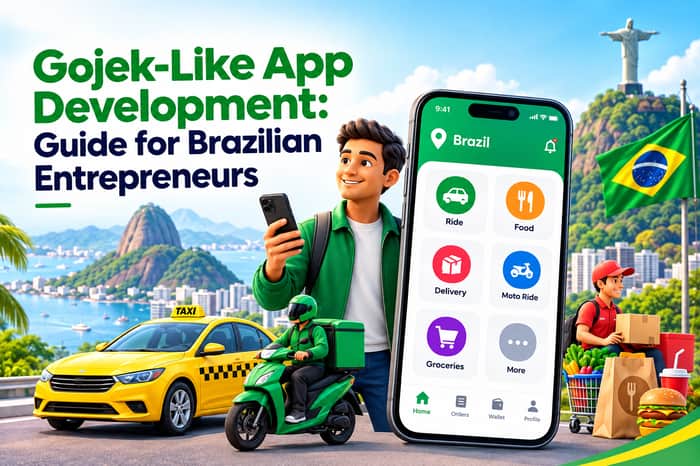
The demand for convenient, app-based services has created new opportunities for entrepreneurs who want to build digital businesses around everyday needs. Instead of using separate apps for transportation, food delivery, grocery shopping, parcel delivery, and home services, consumers increasingly value platforms that bring multiple services together.
This is where Gojek-like app development can provide an interesting business model for Brazilian entrepreneurs. A multi-service application can connect customers with different service providers through a single digital platform while giving businesses multiple opportunities to generate revenue.
For entrepreneurs planning to enter Brazil's on-demand economy, developing a Gojek-like app requires more than simply copying an existing application. The platform should be adapted to the target audience, service categories, payment preferences, operational requirements, and business model.
What Is a Gojek-Like App?
A Gojek-like app is a multi-service platform that allows users to access several on-demand services from one application.
Depending on the business strategy, an app can combine services such as:
- Taxi and ride booking
- Food delivery
- Grocery delivery
- Parcel delivery
- Courier services
- Medicine delivery
- Beauty services
- Home cleaning
- Handyman services
- Laundry services
- Restaurant ordering
- Local shopping
- Personal services
The main concept is to create one platform where customers can discover, book, pay for, and track different services.
For Brazilian entrepreneurs, this model can be customized according to local demand rather than attempting to launch every possible service from day one.
Why Consider Gojek-Like App Development in Brazil?
Brazil has a large population spread across major cities and regional markets, creating opportunities for digital platforms that simplify access to everyday services.
A multi-service app can address several customer requirements through one application. For example, a user might book a ride in the morning, order lunch during the afternoon, and request grocery delivery later—all through the same platform.
For entrepreneurs, combining multiple services can also create several revenue streams instead of depending on a single category.
However, the opportunity should be evaluated on a city-by-city basis. Service demand, competition, regulations, logistics, and customer preferences can vary considerably between Brazilian markets.
Services You Can Include in a Gojek-Like App
One of the biggest advantages of a multi-service platform is flexibility. Entrepreneurs can select service categories based on their target market.
1. Ride-Hailing
Ride booking can serve as one of the core services of the platform. Customers can enter pickup and destination locations, select available vehicle categories, book rides, track drivers, and complete payments through the application.
The platform can support different vehicle types depending on the business model.
2. Food Delivery
Food delivery allows customers to discover restaurants, browse menus, place orders, make payments, and track deliveries.
Restaurant partners can receive orders through a dedicated dashboard or application, while delivery partners manage order collection and delivery.
3. Grocery Delivery
Grocery delivery can connect customers with supermarkets, grocery stores, and local retailers.
Features such as product search, categories, cart management, scheduled delivery, order tracking, and digital payments can make the service convenient for users.
4. Courier and Parcel Delivery
A courier service can allow users and businesses to send documents, packages, and other eligible items.
The platform can support pickup and delivery addresses, delivery tracking, driver assignment, pricing, and proof of delivery.
5. Home Services
Entrepreneurs can add services such as cleaning, plumbing, electrical work, appliance repair, beauty services, and other local services.
Customers can browse service providers, compare profiles, select available time slots, and make bookings.
6. Local Shopping
A multi-service application can also connect consumers with local stores.
This can help create an additional marketplace where customers discover products and place delivery orders through the platform.
Essential Features of a Gojek-Like App
A successful multi-service App needs separate functionality for customers, service providers, delivery partners, and administrators.
Customer App Features
The customer application can include:
- User registration and login
- Profile management
- Location detection
- Service discovery
- Search and filters
- Booking management
- Real-time tracking
- Multiple payment options
- Order history
- Ratings and reviews
- Push notifications
- Promo codes and discounts
- Digital receipts
- Customer support
The interface should remain simple even when the application provides multiple services.
Driver and Service Provider Features
Service providers need tools that help them manage bookings and orders efficiently.
Useful features include:
- Registration and verification
- Profile management
- Availability status
- Booking acceptance
- Order management
- Navigation integration
- Earnings tracking
- Transaction history
- Customer communication
- Ratings and reviews
- Notifications
- Withdrawal or payout management
Admin Panel
The administration panel acts as the central management system.
Administrators can use it to manage:
- Customers
- Drivers
- Service providers
- Restaurants
- Stores
- Orders
- Bookings
- Payments
- Promotions
- Commissions
- Service categories
- Reports
- Complaints
- Content
- Notifications
A centralized dashboard can make it easier to monitor different business verticals from one location.
Payment Integration for the Brazilian Market
Payment functionality should be considered during the early planning stage.
A Brazilian multi-service app may need payment methods suitable for its target customers and business model. Depending on the implementation and applicable requirements, entrepreneurs can evaluate options such as cards, bank-based payment methods, digital wallets, and Pix.
The payment architecture should also support transaction records, refunds where applicable, commissions, payouts, and reconciliation.
Before integrating a payment provider, businesses should verify its current availability, fees, technical requirements, settlement process, and compliance obligations.
Localization for Brazilian Users
Localization can have a significant impact on user experience.
A Gojek-like app designed for Brazil should consider:
Portuguese Language
The customer interface, provider application, notifications, help content, and marketing materials should be available in appropriate Brazilian Portuguese.
Brazilian Currency
Prices should be displayed in Brazilian real (BRL) and formatted appropriately for local users.
Local Payment Preferences
Payment options should be selected based on the target audience and supported payment infrastructure.
Address and Location Handling
The application should provide accurate location and address functionality suitable for the cities where the service operates.
Local Business Requirements
Entrepreneurs should also investigate applicable requirements related to transportation, payments, consumer protection, taxation, data protection, employment or contractor relationships, and individual service categories.
How Does a Gojek-Like App Make Money?
A multi-service application can use several monetization models.
Commission
The platform can charge a percentage or agreed fee on completed bookings and orders.
Delivery Fees
Customers can be charged delivery fees depending on distance, service type, timing, or other business rules.
Surge or Dynamic Pricing
For eligible services, pricing can vary according to demand, availability, distance, or other factors.
Subscription Plans
A platform can introduce membership plans offering benefits such as reduced delivery fees, special offers, or other benefits.
Advertising
Restaurants, stores, and service providers may be offered promotional placements within the platform.
Featured Listings
Businesses can pay for enhanced visibility in selected categories or search results.
Using several revenue streams can reduce dependence on a single service category, although each model should be evaluated against customer expectations and operating costs.
How to Develop a Gojek-Like App
Developing a multi-service application typically involves several stages.
Step 1: Define the Business Model
Start by identifying your target customers, service categories, operating cities, providers, pricing strategy, and revenue model.
Avoid launching too many services without understanding the operational requirements of each category.
Step 2: Research the Target Market
Study existing competitors, customer needs, service availability, pricing, provider supply, and potential gaps.
For Brazil, market research should be conducted for specific cities rather than treating the entire country as a single market.
Step 3: Select Core Services
Choose a small group of services for the initial launch.
For example, an entrepreneur could begin with:
Ride-Hailing + Food Delivery + Grocery Delivery
Additional categories can be introduced after validating demand and operational performance.
Step 4: Choose the Development Approach
Businesses can develop the platform from scratch or use a ready-made/white-label multi-service app solution.
Custom development can provide greater control over functionality and architecture, while a ready-made solution can potentially shorten the development cycle when its existing features meet the business requirements.
Step 5: Build the Platform
The development process should cover the customer application, provider/driver applications, backend infrastructure, payment integrations, notifications, location services, and administration panel.
Step 6: Test the Application
Testing should cover:
- Registration
- Booking
- Order placement
- Driver/provider assignment
- Payments
- Refund workflows
- Notifications
- GPS tracking
- Promotions
- Ratings
- Admin operations
Testing should be performed across supported devices and operating systems.
Step 7: Launch in a Selected Market
Instead of attempting to cover Brazil immediately, entrepreneurs can start with a defined service area.
A focused launch makes it easier to build provider supply, monitor customer feedback, identify operational issues, and optimize the platform.
Step 8: Scale the Platform
After validating the initial business model, additional services and locations can be introduced.
Analytics can help identify which services generate demand and where improvements are required.
How Much Does Gojek-Like App Development Cost?
There is no single development price because the total cost depends on the scope of the platform.
Important cost factors include:
- Number of services
- Customization requirements
- UI/UX design
- Number of applications
- Backend architecture
- Payment integrations
- GPS and mapping
- Third-party APIs
- Admin dashboard
- Security requirements
- Testing
- Hosting
- Maintenance
- Post-launch development
A basic multi-service platform will generally require a different budget from a highly customized super app with many service categories.
Entrepreneurs should therefore define the MVP scope before requesting development estimates.
How AI Can Improve a Gojek-Like App
AI can be incorporated into different parts of a multi-service platform.
Potential applications include:
- Intelligent customer support
- Personalized service recommendations
- Fraud detection
- Demand forecasting
- Automated promotions
- Driver or provider matching
- Review analysis
- Chat-based assistance
- Business analytics
- Route optimization
AI should be introduced where it provides a measurable operational or customer benefit rather than being added simply as a marketing feature.
Security and Data Protection
A multi-service platform processes customer, provider, payment, location, and transaction data.
Security should therefore be considered throughout development.
Important areas include:
- Secure authentication
- Role-based access
- Data encryption
- Secure payment processing
- API protection
- Fraud monitoring
- Access controls
- Secure data storage
- Regular security testing
- Backup and recovery procedures
Brazilian businesses should also evaluate requirements under applicable Brazilian data-protection laws, including the LGPD, with qualified legal or compliance professionals where necessary.
Tips for Brazilian Entrepreneurs
Before launching a Gojek-like application, consider these practical points:
Start with a focused service portfolio.
Launching fewer services can make operations easier to manage.
Understand your city first.
Customer behavior and provider availability can vary by location.
Make payments convenient.
Offer payment methods that are appropriate for your target audience.
Prioritize usability.
Multiple services should not make the interface confusing.
Build provider supply early.
A multi-service marketplace needs enough drivers, restaurants, stores, or professionals to deliver reliable service.
Track business metrics.
Monitor bookings, completed orders, cancellations, customer retention, provider activity, revenue, and service-level performance.
Plan for scalability.
The technical architecture should support additional services and locations as the business grows.
Conclusion
Gojek-like app development provides Brazilian entrepreneurs with a framework for combining multiple on-demand services within one digital platform. Instead of building separate applications for every service category, businesses can create a unified ecosystem for transportation, delivery, shopping, and local services.
The key is not simply to reproduce another company's application. Entrepreneurs should develop a platform around their own target audience, selected services, operating cities, revenue model, payment infrastructure, and local business requirements.
A focused MVP, strong localization, reliable service-provider network, secure payment system, and scalable technology can provide the foundation for expanding a multi-service business over time.
Frequently Asked Questions
1. What is a Gojek-like app?
A Gojek-like app is a multi-service platform that combines services such as ride-hailing, food delivery, grocery delivery, courier services, shopping, and home services within one application.
2. Can I launch a Gojek-like app in Brazil?
Yes. Entrepreneurs can develop a multi-service application for the Brazilian market, but the business should be adapted to its target city, customers, service categories, payment methods, and applicable regulations.
3. Which services should I include in a Brazilian multi-service app?
Possible services include ride-hailing, food delivery, grocery delivery, courier services, local shopping, home services, beauty services, and other on-demand categories. The initial selection should be based on local market research.
4. How much does it cost to develop a Gojek-like app?
The cost depends on the number of services, features, integrations, customization, technology stack, design, testing, hosting, and maintenance requirements. An MVP will generally have a different scope and budget from a fully customized super app.
5. Can a Gojek-like app support Pix?
The platform can be designed to support payment integrations suitable for Brazil, including Pix where supported by the selected payment provider and implementation.
6. Can I customize a ready-made Gojek-like app?
Yes. Depending on the solution, businesses may be able to customize branding, UI elements, services, pricing rules, payment integrations, business logic, and other components.
7. How can a multi-service app generate revenue?
Common monetization methods include commissions, delivery fees, subscriptions, advertising, featured listings, and other service-specific charges.
8. Do I need separate apps for customers and service providers?
Typically, separate interfaces or applications are used because customers and service providers require different features. An administration panel is also generally needed to manage the complete platform.
9. Can I add more services after launching?
Yes. A scalable architecture can allow additional service categories to be introduced after the initial launch, provided the technical and operational infrastructure supports them.
10. Can AI be integrated into a Gojek-like app?
Yes. AI can support areas such as customer assistance, recommendations, fraud detection, demand forecasting, analytics, and operational automation.
11. How long does it take to develop a Gojek-like app?
The development timeline depends on the number of services, customization level, integrations, testing requirements, and development approach. A clearly defined MVP can help establish a more accurate project timeline.
12. What should I consider before launching in Brazil?
Entrepreneurs should evaluate their target city, customer demand, competitors, service-provider availability, pricing, payment options, operational model, technology requirements, and applicable legal and regulatory obligations.
