Uber Clone App Development in Australia: Cost, Features & Complete Guide 2026
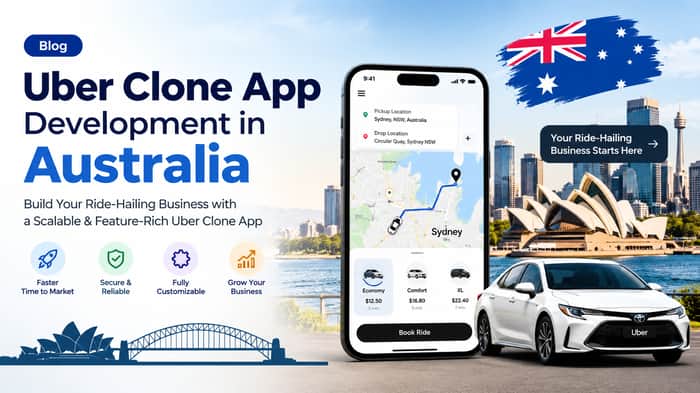
Australia has a growing demand for convenient, app-based transportation. People want to book a ride quickly, know the estimated fare before travelling, track their driver, and pay without worrying about cash. For entrepreneurs, this creates an interesting opportunity to build a ride-hailing business with an app designed around their own brand and local market.
If you are planning to launch a ride-booking business, an Uber Clone App can give you a ready foundation instead of developing every feature from the ground up.
But the big question is: How much does Uber Clone App Development cost in Australia in 2026?
The answer depends on the features you need, the level of customization, the platforms you want to support, integrations, and the development approach you choose.
Let's look at everything you should know before starting.
What Is an Uber Clone App?
An Uber Clone App is a ready-to-customize ride-hailing application inspired by the basic business model of Uber.
It connects passengers with nearby drivers through a mobile platform. A typical solution includes a passenger app, driver app, and admin panel, with the backend working behind the scenes to manage bookings, payments, locations, pricing, and communication.
The important thing is that a clone does not mean copying Uber's branding or proprietary application. Instead, entrepreneurs can use a similar concept and build their own transportation business with:
- Their own brand name
- Their own logo and design
- Custom pricing
- Different ride categories
- Local payment options
- Business-specific commission rules
- Customized driver onboarding
- Additional services and features
This makes the model useful for startups that want to enter the ride-hailing market without starting completely from zero.
Why Start an Uber-Like Ride-Hailing Business in Australia?
Australia is a large and geographically diverse market. From busy metropolitan areas such as Sydney and Melbourne to regional communities, transportation needs can vary considerably.
A local ride-hailing platform can focus on a specific customer group instead of trying to compete everywhere at once.
For example, a startup could concentrate on:
- Airport transfers
- Corporate transportation
- Premium rides
- Local taxi alternatives
- Electric vehicle rides
- Women-focused transportation
- Long-distance rides
- Scheduled transportation
- Accessible transportation
This is where customization becomes valuable.
Instead of creating another generic taxi booking app, you can build an application around a specific problem or customer segment.
What Makes the Development Cost Higher?
Several things can increase the budget, including:
- iOS and Android development
- Custom UI/UX
- Multiple ride types
- Advanced driver matching
- Real-time tracking
- Payment gateway integration
- AI-based features
- Multi-language support
- Multiple currencies
- Corporate accounts
- Advanced analytics
- Third-party integrations
- Complex admin controls
For a startup, launching with essential functionality and expanding later is often more practical than trying to build everything on day one.
Main Components of an Uber Clone App
A professional ride-hailing platform normally has three major interfaces.
1. Passenger App
This is where customers search for rides, book drivers, make payments, and manage their trips.
2. Driver App
Drivers use this application to receive ride requests, navigate to passengers, complete trips, and monitor their earnings.
3. Admin Panel
The admin team controls the entire ecosystem through a web-based dashboard.
The backend connects all three components and keeps bookings, payments, locations, notifications, and user information synchronized.
Passenger App Features
A good passenger experience should be simple. Nobody wants to spend five minutes figuring out how to book a ride.
Easy Registration
Users can create accounts using their mobile number, email address, or supported social login options.
Pickup and Drop-Off Selection
Customers can enter their pickup and destination locations manually or select them directly on the map.
Ride Category Selection
You can offer different categories depending on your business model, such as:
- Economy
- Standard
- Premium
- SUV
- Business
- Electric vehicle
Fare Estimation
Before confirming the ride, customers can see an estimated fare.
Driver Tracking
Once a driver accepts the booking, the passenger can follow the vehicle's location on the map.
Ride Scheduling
Scheduled bookings can be useful for airport trips, business travel, medical appointments, and other planned journeys.
Digital Payments
Customers can pay through supported online payment methods without needing cash for every trip.
Ratings and Reviews
After completing a ride, passengers can rate the driver and provide feedback.
Ride History
Users can view previous trips, receipts, payment information, and booking details.
Driver App Features
Drivers are at the heart of any ride-hailing business. If the driver application is difficult to use, it can quickly affect the quality of the entire platform.
Important driver-side features include:
- Driver registration
- Profile management
- Vehicle information
- Document submission
- Online/offline availability
- New ride notifications
- Ride acceptance
- Pickup navigation
- Trip navigation
- Earnings tracking
- Trip history
- Ratings
- Wallet management
- Support requests
The onboarding process can also be customized according to the operational and regulatory requirements of the Australian market you are targeting.
Admin Panel Features
The admin dashboard gives business owners control over the platform.
User Management
Admins can manage customer profiles, account status, booking history, and support requests.
Driver Management
The dashboard can be used to review driver applications, vehicle information, documents, ratings, and account activity.
Booking Management
Admins can monitor current, upcoming, completed, and cancelled rides.
Pricing Management
Business owners can configure different pricing rules based on ride categories, distance, time, and other factors.
Commission Management
The platform can automatically calculate the business's commission from completed trips.
Coupon Management
Admins can create promotional codes and special offers to attract new customers or encourage repeat bookings.
Reports and Analytics
Useful reports can include:
- Total rides
- Revenue
- Driver earnings
- Customer activity
- Cancellation rate
- Popular pickup locations
- Popular destinations
- Ride category performance
These insights can help business owners make better decisions instead of relying entirely on assumptions.
Australia-Specific Considerations
Launching a ride-hailing application in Australia requires more than simply publishing an app.
Transportation regulations can differ between states and territories. Driver accreditation, vehicle requirements, insurance, registration, safety obligations, and other rules may depend on where your service operates.
For this reason, entrepreneurs should identify their target state or territory before finalizing the driver onboarding and operational workflow.
Your application can then be designed to support the required documentation and verification process.
The technology should support the business — but regulatory compliance should be reviewed separately with the appropriate Australian authorities or professional advisers.
How Can an Uber Clone Make Money?
A ride-hailing business doesn't have to depend on only one source of revenue.
Commission
The platform can take a percentage from each completed ride.
Booking Fees
A fixed service or booking fee can be added to eligible trips.
Premium Services
You can charge higher fares for premium vehicles or specialized transportation.
Driver Subscription
Instead of relying entirely on per-trip commission, you can experiment with subscription plans for drivers.
Corporate Accounts
Businesses can receive dedicated transportation accounts for employees and business travel.
Advertising
Local businesses can promote relevant offers through the application.
Scheduled Ride Fees
Additional charges can potentially be applied to specific scheduled or specialized services, depending on your business model and applicable requirements.
Development Process for an Uber Clone App
Building the application becomes much easier when the project is divided into clear stages.
Step 1: Decide Your Business Model
Start by defining your target customers, service area, ride categories, commission model, and pricing strategy.
Step 2: Select the MVP Features
Don't try to build every possible feature immediately. Select the functionality required to operate your first version.
Step 3: Design the User Experience
Create simple screens for passengers, drivers, and administrators.
Step 4: Develop the Backend
The backend manages authentication, bookings, driver matching, pricing, payments, notifications, and other core operations.
Step 5: Build the Mobile Apps
Develop the passenger and driver applications for your selected platforms.
Step 6: Integrate Third-Party Services
Depending on your requirements, this could include maps, payment gateways, SMS, push notifications, analytics, and other APIs.
Step 7: Test Everything
Testing should cover booking flows, GPS tracking, payments, notifications, account security, performance, and different device types.
Step 8: Launch
After testing and operational preparation, publish the applications and begin acquiring drivers and customers.
Step 9: Improve Based on Feedback
Your first version doesn't need to be perfect. Real users will show you which features deserve priority.
Ready-Made Uber Clone vs Custom Development
Both approaches can work, but they serve different business situations.
A ready-made Uber Clone can be useful when speed and initial investment are important. You start with an existing foundation and customize it according to your business.
A custom-built ride-hailing platform provides greater control over the architecture, user experience, integrations, and long-term functionality.
Choose a Ready-Made Solution If:
- You want to launch faster
- You have a limited initial budget
- Your business model is relatively straightforward
- You want to validate your idea first
Consider Custom Development If:
- You have a unique business model
- You need complex integrations
- You expect large-scale traffic
- You need complete control over the technology
- You require highly specialized features
For many startups, a hybrid approach can make sense: begin with a strong customizable foundation and invest in deeper custom development as the business grows.
How to Reduce Your Initial Development Cost
You don't need to spend your entire budget on advanced features before getting your first customer.
Start with the essentials:
- Registration
- Driver onboarding
- Ride booking
- GPS tracking
- Driver matching
- Fare calculation
- Online payment
- Push notifications
- Ratings and reviews
- Basic admin controls
Once your platform starts generating real usage data, you can invest in more advanced functionality.
This approach reduces unnecessary development and gives you a clearer understanding of what your customers actually want.
Advanced Features to Add in 2026
Once the core platform is stable, you can make your application more competitive with modern features such as:
AI-Based Demand Prediction
Analyze historical booking patterns to help predict high-demand areas and periods.
Smart Driver Matching
Use multiple factors such as location, availability, ride category, and driver performance to improve matching.
EV Ride Category
Create a dedicated category for electric vehicles as part of a sustainability-focused business model.
Corporate Booking
Allow organizations to manage employee rides and transportation expenses from a centralized account.
In-App Safety Tools
Emergency assistance, trip sharing, driver information, and other safety-oriented functions can improve customer confidence.
Multi-Service Expansion
Once the ride-hailing platform is established, businesses can consider adding services such as delivery, courier transportation, or other local mobility options.
Final Thoughts
Building an Uber Clone App in Australia in 2026 is not simply about creating a booking screen with a map. A successful platform needs a reliable driver network, a smooth customer experience, sensible pricing, secure payments, strong administration tools, and an operational strategy suited to the Australian market.
The development cost can vary considerably, but starting with a focused MVP can help entrepreneurs control their initial investment while testing the market.
The smartest approach is to first decide where you want to operate, who you want to serve, and what makes your service different. Once those decisions are clear, the right technology, features, and development strategy become much easier to determine.
FAQs
1. How much does it cost to build an Uber Clone App in Australia?
Depending on the scope, an Uber-like application can range from around AUD 15,000 for a basic MVP to AUD 100,000+ for a highly customized platform. Complex enterprise solutions can cost considerably more.
2. How long does it take to develop an Uber Clone App?
A basic MVP may take around 1–3 months, while a feature-rich customized platform can require 3–12 months or longer.
3. Can I launch an Uber Clone in Australia?
Yes, but you need to consider the applicable transportation, driver, vehicle, insurance, privacy, payment, and business requirements for the Australian jurisdiction where you plan to operate.
4. Can I customize an Uber Clone App?
Yes. Depending on the development approach, you can customize branding, UI/UX, pricing, ride categories, commissions, payment methods, driver workflows, and additional features.
5. Should I build for iOS and Android?
For a broad Australian consumer market, supporting both major mobile platforms can provide wider reach. Your launch strategy can also determine whether both platforms are released simultaneously.
6. Can I add multiple ride categories?
Yes. An Uber-like platform can support economy, premium, SUV, business, EV, or other categories depending on your business model.
7. Can I add scheduled rides?
Yes. Scheduled bookings can be incorporated for customers who want to arrange transportation ahead of time.
8. Is a ready-made Uber Clone better than custom development?
It depends on your goals. A ready-made solution can help you launch faster, while custom development provides greater control and flexibility. Startups often benefit from validating their business idea before making a large custom-development investment.
